When is a MOOC not a MOOC?

Statue of John Harvard, founder of Harvard Uni...
Statue of John Harvard Wikipedia

The Comical of Higher Ed has a headline that says “Harvard U. Will Offer Exclusive MOOCs to Alumni.” After reading the article, the reader learns that what they are doing is giving alumni access to segments of courses and course content. The alumni are not taking a class. If it is not “massive,” if it is not “open,” and it is not a “class,” it is not a MOOC! It is just the “online” part – it is an “O” not a MOOC.

I need to put together a collection of articles that maps out how the CHE has gotten MOOCs completely wrong, and thereby polluting the discourse around MOOCs with misinformation, exaggerations and over-simplifications. It is a huge disservice to the academic community. They seem to have attempted to help by writing up an article about George Siemens.

There are a number of great discussions going on around universities, journals, and the web about what MOOCs are and their possibilities (especially cMOOCs). It is a shame that the CHE misses the boat so often. 

Enhanced by Zemanta
Posted in MOOC | Leave a comment

Open Textbooks and Student Success

Cable Green
Cable Green (Photo: Jeffrey Beall)

The tirelessly brilliant and ubiquitous Cable Green sent out today’s announcement from Creative Commons about the U.S. PIRG Education Fund report called, “Fixing the Broken Textbook Market: How Students Respond to High Textbook Costs and Demand Alternatives.” This report reinforces what the research is already showing – open textbooks can be a significant contributing factor to student success. The results we saw with projects like the Kaleidoscope Project was that students were actually doing better in courses that were using openly licensed, free textbooks. There are a number of reasons for this, but one of the reasons at College of the Redwoods was that the faculty created textbooks were written for a particular student population to solve particular problems. The books actually addressed the needs of the community. You can still find articles out there about the so-called suspect quality of open education resources, but they are being written by folks who have not looked at what is out there now.  Articles like “The cost and quality of open textbooks: Perceptions of community college faculty and students” by TJ Bliss, John Hilton, David Wiley, and Kim Thanos go a long way to dispel those myths as does “A Preliminary Examination of the Cost Savings and Learning Impacts of Using Open Textbooks in Middle and High School Science Classes,” by David Wiley, John Levi Hilton III, Shelley Ellington, and Tiffany Hall.

Commercial textbooks have their own myths to deal with – like whether or not they are reliable!

This is a very dynamic time to be involved in open textbooks!

Enhanced by Zemanta
Posted in OER, Open educational resources, Open textbooks, Textbook | Tagged | Leave a comment

Humboldt State’s Moodle Office is Makes the News!

Humboldt State University
Humboldt State University (Photo credit: Wikipedia)

Our own inimitable Bill Bateman’s video tutorials for Moodle 2.5 are featured at the Moodle News Website as were four of his videos for 2.3.

Bill is the lead Moodle Support Specialist in Humboldt State University’s Moodle Office located on the third floor of the library. Bill’s team manages the day-to-day operations of the learning management system, one-on-one student support, one-on-one faculty support as well as going out to faculty offices and classrooms. The Moodle Office is a good place to drop in for help and a cup of coffee. And if all that wasn’t enough, Bill still takes the time to produce the video tutorials. The instructional design team and I rely on the Moodle Office pretty much on a daily basis.

Moodle News is the international hub for all things Moodle. It is the brainchild of Joseph Thibault a Course Manager at StraighterLine.com, and Mel Benson, a writer who runs Moodlerific.org, a site to share and explore Moodle ideas. She is also Moodle tech support for a school district Minnesota. Moodle News is a valuable resource for all things Moodle: it “is a collaborative project bringing order to news and information pertaining to the open source project and learning management system called Moodle. We scour the web for the freshest, most interesting and valuable Moodle information and publish it here.”

Enhanced by Zemanta
Posted in LMS | Tagged | Leave a comment

#Rhizo14: “Cheating” as Learning Modality

Illustration for Cheating Français : Illustrat...

I have had to address “cheating” in education is a very real way here at Humboldt State. I have instructors who are new to online learning and that is one of the first things they asked – how do we know the students won’t cheat? I usually direct faculty to resources for designing assignments and tests to minimize cheating and how to promote an environment of academic integrity. I wrote a blog posting on academic integrity and ways to minimize cheating last year.

I used to have some students in one of my English classes who would ask me what they had to do to get an “A.” I would tell them to follow the steps in the assignment and turn their work in on time and they would get an “A” and they would say “no, really, what is the system here?” They assumed that there was a back door somewhere or some way to game the system. They thought I was a bad teacher because I wouldn’t tell them. I wouldn’t let them in on the secret. Many of my students saw the end of education, the assessment or final paper as “the product” of education. What I taught though was the process of learning. There were a lot of steps in my class and not really any short cuts. I think that there is a lot to the gamification of learning. I think that letting the students loose on the learning outcomes of a course and letting them discover what the relevant information might be that would address those learning outcomes would teach them a lot about learning. It would also teach teachers how to write precise learning outcomes!

The traditional fears about cheating baffle me. I always say that if the questions you are asking your students can be answered by Google, you are asking the wrong questions.

For every act of “cheating” there should be a corresponding action for “legitimate” learning:

              Cheating                   Rhizomatic

Copying sources without attribution Share sources (social bookmarking) – teach citation
Looking at someone else’s work  Collaborate – Students can create collaborative knowledge via wikis
Buying or stealing the answers to tests Have students create the test questions, debate answers
Sneaking notes into class Open book, open internet tests
Downloading papers from the internet Assignments use the latest news and student experience
Recycling papers Have students create assignments that are relevant

There are some faculty who think that students who do not buy the textbook are cheating. Often, this comes from professors who do not know how much their textbooks cost. Jordan Epp and I discussed the idea of hacking the syllabus a while ago when he told me about a student who did Google searches on the weekly learning outcomes from the syllabus rather than buying the textbook.

Enhanced by Zemanta
Posted in elearning, hack, rhizomatic learning | Leave a comment

Using a Blog-Based Environment to Support a Community of Learners

Presentation notes for: “Using a Blog-Based Environment to Support a Community of Learners”
Institute for Student Success, Humboldt State University
Presenters: Daniel Fiore, Riley Quarles, Claire Knox, and Child Development Faculty

Riley introduced everyone by saying that the network of blogs (WordPress) created with the Child Development department began with solving a problem: communication. Claire Knox pointed out that there was learning that they wanted visible to everyone, they wanted everyone participating in the conversations. They wanted the learning to not be locked down behind a learning management system. Resources for the presentation are at the Child Development site for the Institute.

They created a network of blogs to support their program. The network of blogs arose from the users – the needs of the faculty. All of the course blogs reflect the interest and needs of the individual classes. The blogs serve as eportfolios.

The department blog provides calendars, advising, and a link to all of the other classes. The site supports online and hybrid courses. It allows students to feel and be connected throughout the program.

They also wanted to engage alumni in an open site. They are expanding the community to include former students. Students create their own blogs that feed into course and department sites. They are using RSS feeds and categories in WordPress.

Blog posts help students get to know one another before they work together in the class or in other classes. This has increased the sense of connectedness and community.

The students sign up for a blog at WordPress.com, send the address to the instructor, the instructor puts them into a plug-in that gathers the students postings that are labeled or catagorized according to the class instructions. The pulg-in automatically pulls in all of the materials that the students tag to the class blog. Instructors and students then comment on the postings.

The blogs allow students to explore topics further. The instructor was using the blog to post more articles and resources and the students began to do the same on their blogs.

Carole said that she is not a technological person but found that WordPress was easy to use and the program allows the faculty to go at their own pace in using these tools. The blogs assignments were good tools to discuss web presence, communicating online, and our web history. They had conversations about how the blog can represent the student to prospective employers and how what you put online represents you.

They want the students to carry their experiences in the program and their relationships after they leave the program. Learning management systems do not allow that. They want the learning community to continue.

All of the course content from the courses stays visible. Students can look at other classes and see how course materials are related to other courses. They begin to link what they are learning to their other classes. Students can go and look at any courses that they are going to take in the future. They can see how all the courses fit together. Faculty can also visit the sites and find new ways to make connections to other classes in the program. Typically, faculty in purely face-to-face courses might not have that opportunity. The blogs also serve as a community orientation site.

They have also had a lot of discussions about privacy – there are some materials that they put into Moodle (the learning management system). Observations of children or copy written materials,  for instance, need to be kept private.

Even though the environment looks structured, the community created by the students and their comments represents another network within the network – this is like the idea of rhizomatic learning posited by Dave Cormier. There are opportunities here for collaborative learning and team-based projects. Blogs allow students to communicate their processes, to reflect on how they learn. Peer instruction and support can begin in this network and follow them throughout the program (also much like Eric Mazur’s ideas on peer instruction). This is also a good example of students learning through their connections with one another (connectivism).

Posted in community, connectivism, networks | Tagged | Leave a comment

#Rhizome14: Community as Curriculum

English: Bamboo with rhizome Français : Pousse...

This is my introductory post. I am participating in a MOOC facilitated by Dave Cormier called “Rhizomatic Learning – The Community is the Curriculum.” Dave’s 2008 article “Rhizomatic Education: Community as Curriculum” has informed many of my education projects since including courses, student orientations, professional development, as well as my own teaching which has included English and Health Information Management. Back in 2008, I participated in an early MOOC, Connectivism and Connective Knowlege ’08, and Dave’s article was an essential node. You will notice that on the side-bar of this blog (if you scroll down) you will find the resources for my presentations on the “Connectivist Classroom” and that article is always there. It is also on my reading lists for new instructional designers. I am participating in this MOOC for a number of reasons but one of them is that I am in the middle of developing an online orientation to online learning called “eLearning 101” that I want to run as a MOOC.

I think it is important to practice what you preach and to give back to your community. I have been to too many workshops on “active learning” that were one-way dumps of information. We need to model and practice. I feel as an educator, I want to help shape this new knowledge landscape. That is the difficulty of this kind of education. I can’t get a certification and then shift into neutral! Degrees or past accomplishments don’t mean anything in this environment – you have to participate.

Another reason to participate is that the tools, methods, and people in online collaborative education are always changing. It is important to stay connected!

Related articles:

Enhanced by Zemanta
Posted in Active learning, connectivism, education, elearning, MOOC | Leave a comment

Social Networks and The Good Way to Do History

Biblioteque Nationale (1)
Biblioteque Nationale

There is a fascinating article by Harvard librarian Robert Darnton in this month’s New York Review of Books called “The Good Way to Do History.” It is a review of Arlette Farge’s book The Allure of the Archives. This book was originally written in 1989 before the rise of the internet and ebooks, and yet, as Darnton  points out, Farge’s work addresses issues that are quite relevant. Farge’s work talks about how information travelled in earlier centuries. I think that what we will find is that the patterns of communication are strikingly familiar. Darnton addresses what he says are some of the myths about our time with Farge’s work:

1. We live in the information age.
Darnton says that this is misleading and that every age was an age of information. I agree with this – the networks people created through letter writing and books were slow but just as significant and useful as the networks we have now. He points out that Farge once used the phrase “the logic of the crowd” to talk about how inflammatory information spreads revolt – much like Twitter in our age but through word of mouth. “The logic of the crowd” is like Howard Rheingold‘s concept “Smart Mobs.” As Darnton puts it:

“Farge shows how information traveled through the media of eighteenth-century Paris. Primarily oral but intermixed with printed material such as chapbooks and popular engravings, the flow of talk and images (also, I would add, songs) shaped a collective consciousness that often erupted in violence.”

I have a note here on the Republic of Letters that describes some of these early modern networks.

2. All information is available online.
Darnton says that this is false. He says that there are an estimated 129,864,880 books and Google has only digitized 20,000,000 of them. He discusses the miles of archives that exist: 252 miles of them in the Biblioteque Nationale alone. Although I get his point, the significance of Google is that I do not have to be a member of an elite academy to get access to the information. The internet can represent the democratization of information (and yes, there are problems to overcome with that idea). Farge documents in her book the arduous process she had to go through to get access to the archives.

3. The future is digital.
Darnton calls this myth true but trite and misleading. The death of the book is routinely predicted since the invention of just about every other media (movies, television, comic books, etc.). Darnton points out that “more books are produced each year than the year before – an increase of 6% in the United States in 2012.” He goes on to say that new media actually expand and enrich the experience of the old.

I think it is important that I read outside of my discipline. We need to stop thinking so much about specific disciplines and make the connections between them to solve problems. Sometimes it feels like we spend a lot of time reinventing the wheel by addressing issues that may have been solved, in part, by other scholars elsewhere. I really appreciate publications like the New York Review of Books because it gives me a chance to read about what is happening in other fields and make connections that I would not readily be able to make.

I actually bought the Kindle version of this book. I like to read physical books as much as anyone else but this is a short one and I could not resist the price or the irony.

Enhanced by Zemanta
Posted in communication, connectivism, history, social networks, twitter | Tagged , , | Leave a comment

eLearning 101: Presentation from DET/CHE

I went to the DET/CHE conference in November and I had a presentation that I was going to give. What happened at the conference was interesting. After listening to other presentations and listening to the concerns, fears, and needs of other presenters, I wrote a brief “prelude” as a response. I also added more notes in the notes field. I am glad I had the opportunity to do this. Presentation from DET/CHE conference:


I was really impressed that the educators I met at the DET/CHE conference. I have received a lot of offers for help, advice, and some constructive criticism around our ideas about an orientation MOOC. I will definitely put the next DET/CHE on my calendar!

Enhanced by Zemanta
Posted in connectivism, education, elearning, MOOC | Tagged , | Leave a comment

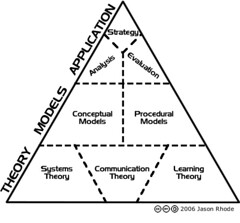
DET/CHE: Cognition, Learning Theory, Backward Design: The importance of instructional design.

Hierarchy of Instructional Design
Hierarchy of Instructional Design (Photo credit: jrhode)

Jim Monaghan, AVP Academic Technologies/Associate Professor, Educational Technology, CSUSB

Instructional designers take on many roles at campuses. The perspectives of the designers combined with the organizational structure of the campus can greatly impact the results of the instructional design process. This presentation examines the importance of instructional design to the construction of high quality learning environments. Topics to be covered include fundamental principles in cognitive science, learning theories and backward design. Implications for the design of courses which range from technology-enhanced to technology-centric (e.g. fully online courses and MOOC’s) will be presented. Applications of instructional design in strategic planning for learning environments as well as practical considerations for implementation of strategies will be discussed. Advantages and disadvantages of a variety of organizational reporting structures will be explored. Specific ideas participants will take away from the session

• Importance of instructional designers to the development of high quality courses that use educational
technology
• Importance of organizational structure in facilitating instructional design for learning
• Overview of cognitive science that applies to the instructional design process

MOOCs, the model from Thrun,

Its about design, not technology

Design Considerations
Why would online video work?
What do we lose when we record a lecture?
How do we allow for substantive interactions?

He refers to the WASC handbook for interactions online.

What can tech allow us to do that we couldn’t do otherwise?

Backward Design
Start with the end in mind – quote from Stephen Covey
Could also be from McTighe

Key elements of ID

What do you want your students to know’
How will you know that students have met the objectives
Interaction
Other considerations

A review of learning theories.
Behaviorism, Constructivism, Constructionism

He claims that drill and practice has its place. [I disagree with
this, I think you can learn the same with contextual learning.]

Social constructivism, situated cognition

Refers to a 1999 paper that applies cognitive science to designing
learning spaces. “Designing Learning: Cognitive science principles for
the innovative organization” Penuel & Roschelle.

What is the role of instructional designers?

CSUSB Online Learning Modules Template

1. Reading
2. Short lecture
3. Discussion
4. Student research
5. Assessment

Where are instructional designers housed in your organization?
Why does it matter?

Access to infrastructure
Access to decision makers
Responsiveness
Agility
Strategic or operational focus

Related articles

Enhanced by Zemanta
Posted in design, elearning, Instructional Design | Leave a comment

DET/CHE: Teaching in the Digital Age

Azusa Pacific University
Azusa Pacific University (Photo credit: Wikipedia)
Mike Truong, Founding Executive Director, Office of Innovative Teaching and Technology, Azusa Pacific University
 
The demands faculty teaching in the digital age face are immense rom keeping distracted students engaged (high touch) to keeping current on the latest technologies (high tech).
This presentation will provide some proven strategies on helping faculty meet these challenges.
Specific ideas participants will take away from the session
…
•  Articulate the challenges of teaching in the digital age.
•  Explain how technology can meet some of these challenges.
•  Emplo best- practices for teaching with technology.

Where as other voices are overly critical of MOOCs or on the other extreme overly Utopian, Mike says he is in the middle, looking at technology pedagogically.

He gave an extensive quote from Hamlet’s Blackberry.
We need space between our tasks to reflect.

He then talked about the “really cool” Domino’s pizza app. “It is
amazing what you can do with ordering pizza now a days.”

He is excited about the apps that allow you to buy glasses and take a
picture of a paycheck and electronically deposit it.

You can buy a house online – you can buy a house without even looking  at it.

“We are immensely better because of technology.”

We can learn any time, place, and device.

Students are demanding that faculty use more and more tech in the classroom.

Pedagogy – gains, losses, and implications

The essay is a good model for learning critical thinking  – but it is too alphabetic-centric. Word processing helps us but it promotes linear thinking.

Technology – Jose Bowen – technology maximizes teachers face-to-face contact with students. Henry Jenkins says that technology encourages participation. Sugata Mitra – technology self-educates.

He makes the claim that “the internet harms our ability to engage with difficult text and complex ideas” a quote from Nicholas Carr. Clifford Nass says that “Media multitasking impairs our focus, productivity, and creativity.” We are losing the ability to focus on one task at a time. He gives the argument of Sherry Turkle’s Connected Alone.

He comes back to Wiliam Powers Hamlet’s Blackberry.

He then talked about the story in Wired “Minimally invasive learning.” – the issue that has “The Next Steve Jobs” on the cover.

Technology’s proper role is to supplement the learning.

Related articles

Enhanced by Zemanta
Posted in education, technology | Tagged | Leave a comment