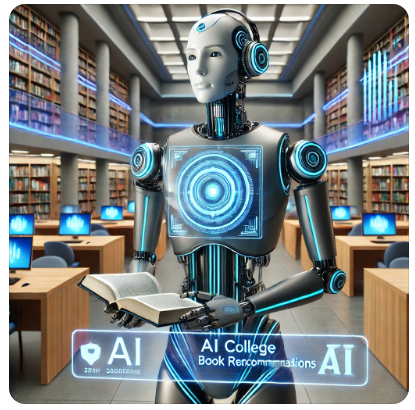
 I am working on a Information and AI Literacy module (or short course) with our librarian and I never ran it through AI. The content is just okay, there are a few articles I have not read, so that is useful. The books and toolkit section is weak – I asked for more and got a couple of more relevant articles. I thinking bringing the librarians into this conversation is important. It is what we did in the 80s and 90s with the rise of digital spaces and the internet. The librarians have always been on the cutting edge – here is my experiment:
I wrote: Act as a College Librarian with an extensive teaching background, you will write a short article for new community college librarians on teaching a course on Information and AI Literacy. Provide a list of resource recommendations and other articles and papers that are easily accessible on the internet at the end. You prefer openly licensed content if possible.
Teaching Information and AI Literacy: A Guide for New Community College Librarians
As generative AI continues to shape the landscape of education, information literacy must evolve to include an understanding of artificial intelligence. Community college librarians are uniquely positioned to bridge this gap, empowering students to navigate, evaluate, and use AI tools ethically and effectively. This article outlines strategies for teaching a course on Information and AI Literacy and provides a list of open-access resources to support your teaching.
Why Teach Information and AI Literacy?
Students are engaging with AI tools like ChatGPT, Google Bard, and image generators, often without a clear understanding of how these systems work or their implications. A course on Information and AI Literacy can help students:
- Critically Evaluate AI Outputs: Develop the skills to assess the credibility and accuracy of AI-generated content.
- Understand Bias and Ethics: Explore how algorithms reflect biases in their training data and the ethical considerations of using AI.
- Develop Lifelong Learning Skills: Equip students to adapt to emerging technologies and discern credible information in an AI-driven world.
Key Components of the Course
- Foundations of Information Literacy
- Reinforce traditional information literacy concepts: evaluating sources, understanding authority, and distinguishing between fact and opinion.
- Introduce the concept of algorithmic literacy to help students understand how search engines and AI tools rank and generate information.
- Understanding AI Basics
- Offer an accessible introduction to AI: What it is, how it works, and where it is commonly used.
- Use practical examples to demystify AI tools and foster curiosity.
- Hands-on Exploration of AI Tools
- Provide opportunities for students to use generative AI tools, such as ChatGPT or DALL·E.
- Assign tasks like generating summaries, creating visuals, or analyzing datasets, followed by discussions on their accuracy and biases.
- Critical Thinking and Ethical Use
- Discuss the ethical implications of AI, including privacy concerns, misinformation, and intellectual property issues.
- Guide students in understanding responsible AI use, including disclosure and attribution when using AI-generated content.
- Project-Based Learning
- Encourage students to apply their learning through projects, such as evaluating an AI-generated article or creating an infographic explaining AI ethics.
Tips for Success
- Start with What Students Know: Many students have interacted with AI in some capacity. Use their experiences as a starting point for discussions.
- Collaborate with Faculty: Partner with instructors from other disciplines to integrate AI literacy into existing courses.
- Stay Current: AI technologies evolve rapidly. Dedicate time to staying informed about new tools, trends, and ethical debates.
Recommended Resources
Open-Access Articles and Papers
- “Algorithmic Literacy and the Role of Libraries in the Age of AI”
Published in: Library Trends, 2023
Link: https://doi.org/10.1353/lib.2023.0032 - “Generative AI and Libraries: An Introduction”
Published by: International Federation of Library Associations (IFLA)
Link: https://www.ifla.org/publications/2023/09/generative-ai-and-libraries/ - “AI Literacy: What It Is and Why It Matters”
Authors: Aras Bozkurt et al.
Published in: Open Praxis, 2023
Link: https://openpraxis.org/articles/10.55982/openpraxis.16.3.739 - “Teaching AI Literacy: A Guide for Librarians”
Published by: Educause
Link: https://www.educause.edu/teaching-ai-literacy-guide - “The Role of Libraries in Supporting Algorithmic Transparency and Accountability”
Published in: Information Research, 2022
Link: http://informationr.net/ir/27-2/paper959.html
Openly Licensed Content
- AI Ethics Curriculum for Libraries
By: Open Education Consortium
Link: https://www.oercommons.org - Digital Competency Frameworks and AI
By: European Commission
Link: https://ec.europa.eu/digital-skills/
Books and Toolkits
- “Data Feminism” by Catherine D’Ignazio and Lauren F. Klein (Open Access)
Link: https://data-feminism.mitpress.mit.edu/ - “AI for Everyone: A Hands-On Guide” by Andrew Ng (Open License Course)
Link: https://www.deeplearning.ai/ai-for-everyone/
AI Tools for Exploration
- ChatGPT: Analyze generated content critically.
- AI Test Kitchen by Google: Experiment with cutting-edge AI tools.
- DALL·E: Explore how AI creates visual content.
By teaching Information and AI Literacy, you not only help students understand the tools they already use but also equip them to navigate an increasingly AI-driven world with confidence and critical awareness. As librarians, you can lead this vital educational effort while fostering a culture of ethical and informed AI use.
I then wrote: I need five more articles and five more books and toolkits.
Expanding your resources for teaching Information and AI Literacy, here are additional open-access articles and books/toolkits that can enhance your curriculum:
Additional Open-Access Articles:
- “AI Literacy in K-12: A Systematic Literature Review”
Authors: Jiahong Su, Yuchun Zhong, Davy Tsz Kit Ng
Published in: International Journal of STEM Education, 2023
Summary: This article reviews existing literature on AI literacy education in K-12 settings, providing insights into effective teaching strategies and curriculum development. - “Artificial Intelligence and Education: A Reading List”
Published by: JSTOR Daily, 2023
Summary: This curated reading list offers a selection of articles exploring the intersection of AI and education, highlighting key discussions and research findings. - “Why Generative AI Literacy, Why Now and Why it Matters in the Educational Landscape?”
Author: Aras Bozkurt
Published in: Open Praxis, 2024
Summary: This editorial emphasizes the importance of AI literacy in education, discussing the need for inclusive AI learning designs and the role of generative AI in enhancing educational practices. - “Codesigning AI with End-Users: An AI Literacy Toolkit for Nontechnical Users”
Authors: Multiple authors
Published in: Interacting with Computers, 2024
Summary: This study presents an AI literacy toolkit designed for nontechnical users, emphasizing the importance of user-centered design in AI education. - “Build Your Own Robot Friend: An Open-Source Learning Module for Accessible and Engaging AI Education”
Authors: Zhonghao Shi, Allison O’Connell, Zongjian Li, Siqi Liu, Jennifer Ayissi, Guy Hoffman, Mohammad Soleymani, Maja J. Matarić
Published in: arXiv, 2024
Summary: This paper introduces an open-source learning module that enables students to build their own robot companion, providing hands-on experience with AI concepts.
Additional Books and Toolkits:
- “AI Literacy in K-16 Classrooms”
Editors: Davy Tsz Kit Ng, Jac Ka Lok Leung, Samuel Kai Wah Chu, Maggie Shen Qiao
Publisher: Springer, 2023
Summary: This open-access book examines different aspects of AI literacy education, offering theoretical discussions and practical recommendations for curriculum design. - “Creative Applications of Artificial Intelligence in Education”
Editors: Alex Urmeneta, Margarida Romero
Publisher: Springer, 2024
Summary: This open-access book explores the synergy between AI and education, highlighting its potential impact on pedagogical practices and suggesting practical ways to personalize instruction. - “Optimizing AI in Higher Education: SUNY FACT² Guide, Second Edition”
Authors: Lynn Aaron, Santina Marae Abbate, Nicola Allain, Brian Fallon, Dana Gavin
Publisher: SUNY, 2024
Summary: This open-access guide provides updated information reflecting the changing landscape of generative AI technology, offering practical suggestions for educators and students to achieve AI literacy. - “Generative AI in Education: A Guide for Parents and Teachers”
Author: Paolo Narciso
Publisher: Springer, 2024
Summary: This book serves as a comprehensive guide to generative AI in education, empowering parents and educators to navigate this new frontier and integrate AI into teaching and learning. - “An AI Toolkit for Libraries”
Author: David Stuart
Published in: Insights, 2022
Summary: This article outlines a framework for evaluating AI-based tools in libraries, providing criteria for assessment without requiring detailed technical knowledge.
These resources offer valuable insights and practical tools to support your efforts in teaching Information and AI Literacy, ensuring that students are well-equipped to navigate the evolving digital landscape.