Drones and Education: a view from above

Aerial view of University Place, WA

Aerial view of University Place, WA

Now I am not going to pretend like I am doing anything right now with drones except having a lot of fun and taking some interesting pictures. But I am in the education field and I have been reading articles about drones in education. There are a lot of possibilities listed by the authors. Some of them are around the STEM side of things: “students will learn how to build drones” which is a worthy pursuit but seems strangely self-referential. There are a number of articles directed at elementary educators that claim that we should use drones because “students find them engaging.” This is never a good enough reason to use any technology. What is more important is to show students how the technology can solve problems. Novelty fades but learning how to solve problems is a deeper engagement.

I have worked on a Rangeland Management grant and drones seem like a natural for that field. Drones certainly bring down the cost of aerial photography which would be a boon to forest and watershed management, geology, etc. Combining drones with Google Maps and other applications could provide some very powerful research tools. App creators are already building apps that tell drone pilots where it is safe to fly which requires them to integrate a number of online tools.

Hubsan Drone

Hubsan Drone

Here is my current reading list on drones:

If there are articles that you have read on drones in education that you think we should know about, feel free to contact me or leave a reply below.

Posted in technology | Tagged , , | Leave a comment

Asking the Wrong Questions About Captioning

Closed Captioning 2

Closed Captioning 2 (Photo credit: Wikipedia)

I first read about this at Stephen Downes’ blog, a study entitled “The Effects of Captioning Videos on Academic Achievement and Motivation: Reconsideration of Redundancy Principle in Instructional Videos” by Muzaffer Ozdemir, Serkan Izmirli, and Ozden Sahin-Izmirli. In their abstract they state that “in contrast to the suggestion of the redundancy principle, motivation and achievement scores of students do not vary according to the instructional video type under investigation (captioned vs. non-captioned). Thereby, it was concluded that a moderating effect of the streaming feature of instructional material should be considered to interpret the redundancy effect.” I do agree with them that more studies should be done on this aspect of captioning BUT, this is NOT why we do captioning in the first place. This question of the redundancy principle completely misses the point of why we do it. Do you know whose motivation and achievement scores will suffer with no captioning despite this study? The deaf, the learning disabled, and ESL students. This is why captioning is the law. Also, according to the flowchart, captions are a distraction. I think these videos do not have to have the captions burned in. In YouTube for instance, you can turn them off. Further, we did captioning at College of the Redwoods and in viewing the analytics of the transcripts and the use of captioning, the users most often likely to use them were the students in the nursing dept. who are all top students (they have to be to enter or finish the program) and their number one reason was that it helped them remember what was said.

I am really hoping that articles like this will not discourage faculty and administrators from making their materials accessible. Please contact me if you would like to further discuss the tools and methods for making online materials accessible.

Posted in Accessibility | Tagged , , , , , , | 3 Comments

Free CC0 Videos – Pexels Videos

Deutsch: Schild an einem Lokal in Granada, das...

Schild an einem Lokal in Granada, das nur CC-Musik spielt (Photo credit: Wikipedia)

Video can be an important component in online courses. Even though our lectures and demonstration videos may seem sufficient, getting other supplemental resources in to a class can help students learn as supplemental content can provide information from a different viewpoint. While working on video projects to beef up my editing skills, I came across Pexels which uses a “Creative Commons 0” license – more on that license from their site:

Pexels Videos offers completely free videos. All videos are licensed under the Creative Commons Zero (CC0) license. This means you can edit or change the videos and use them free for personal and even for commercial projects. All without asking for permission or setting a link to the source. So that attribution is not required. With our swiftly growing database of videos, you are guaranteed to find the perfect footage for your website header, product promotion, or anything else. Every video we have available is free for any purpose – including commercial. This guarantees that you will be saving the hundreds of dollars better spent promoting your brand. The CC0 license was released by the non-profit organization Creative Commons (CC). You can find more information about the license on the official license page.

Source: Free CC0 Videos – Pexels Videos

As I wrap things up, I will put up a list of useful video sites for developing instructional materials. Please list any of your favorites in the comments section below.

Posted in media | Tagged , , , , , , , | Leave a comment

Pokemon Go and Online Education

Magical Pokémon Journey

Magical Pokémon Journey (Wikipedia)

So be prepared for the flurry of edublog posts on Pokmon Go claiming that it is the future of education. My wife has been playing for the last week. We were watching Casey Neistat’s vlog and he kept running into people on the streets of New York playing it. They were everywhere. Within days, they were all over Humboldt County. She downloaded it and went to work. I am not sure how long she will last because she doesn’t seem to have the patience to deal with the crashed server or her phone crashing. At least Pokemon Go has that in common with most education technology – not built for scale. It has been a great case study watching her get into this. She has hit a few walls, found the online community to help her out, experienced extreme cognitive dissonance when she saw her first Pokemon cartoon (no, information from the cartoons does not help), and she has enjoyed minor triumphs and has run into others playing the game.  There is a lot here that instructional designers and edutech folks have seen in just about every roll-out or implementation of technology. This includes all the hand-wringing, nay-sayers who see this as the End of the World as We Know It. But Pokemon Go is successful: people are engaged, having fun, meeting one another, and the company is worth 11 million more dollars. Yes, there are some hitches: server issues, accidents, robberies, etc. But there are four ways in which the success of Pokemon Go mirrors successful online courses:

  1. Interactivity and Engagement
    The game is simply designed. In a few minutes, new users with no gaming experience can figure either how to play or learn how to learn how to play. This is great game design and good instructional design. The game-play (or learning) should scaffold skills that will allow the learner to easily move on to the next action or level. If the ball can be thrown, it will move to give you a hint. We have explored elsewhere in this blog the connection between student retention and success and interactivity in an online course.
  2. Community
    Great online courses and great online colleges encourage and build community. Pokemon Go has a built in community of gamers who can easily find one another on maps. This is also a part of engagement. This is why I think learning management systems have really missed the boat – it is so hard to shoe-horn social networks into proprietary systems like commercial LMSs. And yet, texting, messaging, Instagram, etc. is so much a part of a student’s life. The gamer world gets this: education has yet to dive in.
  3. Self-Directed
    For some students, nothing is more tedious than listening to someone explain how to do something when you know that the only way you are going to really learn is by doing it. These tend to be your kinesthetic learners. Online classes and programs need opportunities for students to take a self-directed path – either to learn the subject or to fill in gaps of missing knowledge or experience. We should be designing our courses with the same kind of scaffolding found in the best games: not just the subject matter but for the technology required for the student to be successful.
  4. Mobile
    Pokemon Go is not played on a console or a proprietary device. The company knows that the players are all using smart phones. They are leveraging the devices that the students already have – devices that players always have with them. Online learning has at least moved towards making the learning materials accessible by phone, but it is up to the teachers and instruction designers to come up with lessons that take advantage of these devices that are encyclopedias, cameras, multimedia creation platforms, and oh yes, phones. Lets put down the wax tablets and get with the program!

I don’t see a revolution or real change coming from Pokemon Go in education, but I think it is important to see how and why other online experiences are successful. The world of online education could learn from this.

Posted in games | Tagged , , , , | Leave a comment

Five Essentials for Change Mangagement

Map and WatchWhen colleges and universities have conversations around “change management” there is usually technology involved: an eportfolio, email software, student information systems, etc. Having been through a number of these kinds of changes, I think I have learned a lot about change management. It is all about the way, not the technology. Even though there is technology involved, it is more important to put a process in place that routinely evaluates the needs of faculty, students, and staff. One that is an integral part of transparent, participatory, and collaborative governance. Anything less than that is doomed to fail in some way or another. Let’s take changing a learning management system for example: changing how teachers will teach online and how students will learn is a big change. To make this change successfully requires a lot of buy-in and support. There is a way to get there, but interestingly enough, the method used for each institution will be different. Why? Because each campus has its own culture, needs, assets, liabilities, and politics. You can create a general road map, but that map has to be informed by the needs of faculty, students and staff. Here are what I think are five essential points on that map:

1. Annual Needs Assessment and Review
If it ain’t broke, don’t fix it, but how do you know what is working and what isn’t? If there is not a cycle of assessment and review on your campus, this is a good time to bring that up. A “needs assessment” is a systematic process for determining and addressing needs, or gaps between the current conditions and desired conditions. The difference between current conditions and the desired conditions determines the current needs. This can’t be a one time process. It is essential that administrators and faculty work together to make this an annual, on-going process.

2. Communication: Focus on the “Why”
Advertise the needs of the university, not the bright and shiny new software. If there is a strategic plan for the college, make sure that the eLearning or IT department also has a strategic plan aligned with it that accounts for this kind of change. Create an atmosphere on your college where stake-holders are encourage to talk and share their needs and vision for teaching and learning on campus. This can include formal and informal meetings (brown bag lunches), as well as online forums. When working for vendors, keep this focus. When sales people ask to do a demonstration on your campus, ask them to bring in faculty that can show exactly how they use the tool to solve problems or teach.

3. Stake-Holders and Buy-In
Faculty, staff, and students need to be actively involved early on in the process. They should be the process and not added on as an after-thought because they will feel like they were added on as an after-thought. Renee Carver and Katrina Fuller of Lower Columbia College have an online presentation of their process called “Piloting the Canvas LMS” that has a lot of the right steps. I was particularly impressed with the make-up of their committee: 35 faculty, 17 staff, and 10 students.  Marie Nathalie Moreau suggests that you “be inclusive in who you invite to the different meetings regarding the LMS migration. Often times, people who feel excluded from decisions become disengaged.” I especially appreciate her point that “a permanent committee on change management can evolve from these discussions.” Don’t miss an opportunity to build community and relationships that will help your institution solve other problems down the road.

4. Create a Community of Support
Part of the needs assessment process can include an inventory of campus assets. These assets include processes, committees, and people who are already in place who can make a positive contribution to change management on campus. It is just as important to effectively leverage the assets that are working as it is to know where the needs are. I am often faced with faculty who are frustrated because they are not sure where they should go for questions about changes in eduction technology. Again, creating a culture of communication on campus will go far in alleviating this frustration and increase buy-in.

5. Do Not Reinvent the Wheel
Although this process has to be customized to the needs of each campus, it is important to understand what has happened in the larger academic community around the LMS. Some have gone for hosted solutions, some host on campus, some have gone open source and others commercial. There are those who are looking at “open pedagogy” and open tools outside of the LMS. Research into how other universities have managed those changes can help your campus make decisions and avoid pitfalls which can include things like letting the vendors drive the conversation or allowing one or two administrators make the decision for everyone for expediencies sake. The price will be too painful in the end. Talk to other campuses but make collaborative decisions based on what works best for your university. You do not need to find the best LMS but the best solution for your particular campus.

Bonus: Hire a Consultant
This is the self-serving suggestion at the bottom of the post. One strategy is to find a consultant who can help facilitate the discussions on campus, assess the needs, and help create a community of support. There are advantages to bringing a neutral party on to campus. A consultant can help keep the spot light on the strategic plan, the needs of the students and faculty, and teaching and learning. Many of the perceived needs on a campus may not need a new technology solution at all but a better support structure for the current systems, or a combination of solutions. A consultant can also help customize the process to properly assess the needs of your campus where as a vendor is already coming in with a pre-packaged, one size fits all “solution.” For instance, your campus may be ready to talk about what is beyond the LMS. In fact my thinking right now is that so many of the learning management systems are essentially the same (with one or two rising to the top) that the LMS vendors should be more concerned with facilitating change management than software sales.

Posted in change | Tagged , , , , , , , | Leave a comment

On Learning Objectives: A Response to Jeff Noonan

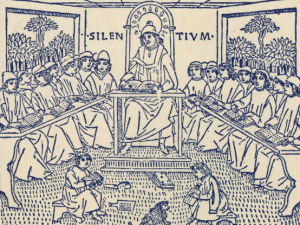
Lecture circa 1400 (Getty)

Lecture circa 1400 (Getty)

Jeff Noonan wrote a great blog posing called “Ten Theses In Support of Teaching and Against Learning Outcomes.”I have called this a “response” but what it is really semi-random notes. This will be one of those postings that folks in education will be batting around for a while. It is seriously worth a look. I am very interested in learning objectives because they have been part of my career in education from the beginning. I started out in education support as a tutor, subbed in the k-12 system; worked in writing labs, taught English in community colleges in California and Washington; worked as an instructional designer and a college administrator, and in all of this work, learning objectives played a big role. Every grant I have worked on has asked for them. All of the quality assurance rubrics for developing or reviewing online classes ask for them. College administrators and faculty review course learning objectives to judge whether or not a course from another college is equivalent to a similar course at their college. Learning outcomes are as deeply ingrained into education as the lecture method of teaching. These are not arguments in favor of learning outcomes. In fact, I came from an experimental high school (Delta High, Orcutt, CA) where the students were given an opportunity to figure out what they were supposed to learn and worked out with an advisor to work out how they were to learn it. I don’t disagree with the “Ten Theses” – I just think that the document is not coming from the same education culture that most students are currently subjected to. The establishment objections to them would certainly be something like “How do we know if the student has learned to love thinking?” And can someone learn to love thinking and not have learned how to speak French or work out an algebra problem and still pass the class?

In the first thesis, Noonan writes “Teaching does not instruct or transmit information, it embodies and exemplifies the commitment to thinking.” I get the spirit behind this, but there are college classes that really are just rote learning: memorizing formulae, the names of bones, etc. Experiences in a typical college that embody and exemplify teaching are rare. And this is the fault of the system, I am not sure how this thesis could be implemented without a huge, revolutionary over-haul of education.

The second thesis says that “True teaching is thus a practice, a performance of cognitive freedom which awakens in students a sense of their own cognitive freedom.” So there is that critical qualifier “true teaching” versus what ever is passing for teaching now-a-days. Deciding what constitutes “true” teaching and what that practice looks like in the day-to-day classroom seems to be the work of instructional design and teacher education (which is something that does not happen in higher education).

In the third thesis, we learn that “All successful teaching therefore results in students who love to think and never stop thinking for the rest of their lives. This result is very different from mastering a certain body of knowledge or learning to apply certain rules to well-defined situations.” Again, we have a qualifier “successful” teaching. All I can say is that if you do not have tenure, and your students have not mastered the body of knowledge you are supposed to teach and do not know how to apply it, you may not get tenure despite how much your students love to think. That said, I agree with the principle behind this, but we have to work on what really constitutes “successful teaching” and how to get there.

The fourth and fifth theses describe the love of thinking and critical thinking, and the fifth ends with the statement: “Learning outcomes confuse the ends (thinking) with the means (content and skills) and set out to measure how well the students are mastering the content and the methods.” I disagree with that. Learning outcomes only describe the content and methods. Learning outcomes avoid abstract unmeasurables like the “love of thinking.” How will Noonan know if I really love learning or am only faking it?

In the sixth thesis, Noonan says that learning outcomes “they are part of a conservative drift in higher education towards skill-programming and away from cultivation of cognitive freedom and love of thinking.” I think that describing what a student will get out of a class or a description of what is being taught does not have to exclude cognitive freedom and a love of thinking. If I am taking an Administrative Justice class called “Evidence,” it is helpful to know that students enrolled in the class will be able to identify what constitutes legally acceptable evidence and what does not. I know that a teacher can teach that course in such a way that that a love of thinking is cultivated. Eliminating learning outcomes won’t do that.

The seventh thesis says that what learning objectives “achieve is a narrowing of the scope and aims of classroom interaction to skilling and information transfer.” I don’t think that telling the students, other faculty and institutions what skills and knowledge the students will gain from the course precludes a love of thinking. If students take an organic chemistry course, they had better learn organic chemistry. I would hope to god they took it from someone who can communicate the love of thinking that can happen in chemistry classes but ask any student – it rarely happens. Many classes are taught in a particular way because that is how the instructor learned it. Some classes are, in fact, used to haze students out of the field in favor of more “serious” students (i.e. students with better rote memorization and hoop jumping skills). This is why there are so few minorities and women in STEM.

In the eighth thesis, Noonan says that “In their belief that only that which measurable is real, defenders of learning outcomes show themselves to be another example of a society-wide cognitive derangement that confuses the value of practices and relationships and activities with their measurable aspects.” This does not necessarily have to be the case: one can write learning objectives in such a way that they address practices, relationships and activities. No one is saying that the only thing one will learn in a class will only be found in the learning outcomes. Again, this sounds like an instructional design issue and not a learning objectives issue.

The ninth thesis claims that “learning outcomes presuppose and reinforce a consumeristic attitude towards education. They present the purpose of pursuing a course of study as the purchase of a defined set of skills and circumscribed body of information which can then be used as a marketing pitch to future employers.” To a certain extent I agree with this, but we have to also ask, why are students going to college? There are a number of studies that say that students are going to college to get better jobs and to make more money. If a student majors in philosophy, the odds are that they are going to go into law, government, or healthcare. It would be a rare student (or independently wealthy one) who would say that the only reason they are going to college is for the love of thinking or even learning for learning’s sake.

And finally, the tenth thesis says that there is no clear pedagogical outcome to learning objectives and that they are a fad. I have heard this said before and yet, the first time I ran into a discussion of learning objectives in a college was in the United States in 1985.

I remember my first Latin class at UC Berkeley. My impression was that this was supposed to be a top school. On the first day, the instructor lead us in reciting verb conjugations as a class in unison. This was to help us remember the conjugations via rote memorization. The instructor said that it was the only way to do it. I left that class and never went back. Fast forward a few years and I was at Sonoma State. The instructor used an older textbook and brought in texts for us to translate together. A few times, he brought in texts from colleagues in Europe that had never been translated into English. We learned all the grammar that we needed by working on actual projects, but to this day, I still run into Latin teachers who balk at teaching from original texts because that is not the way that they learned Latin. My point is that both classes had similar learning objectives but the design of the course was different. I am sure the students at Berkeley learned something of Latin grammar, but I am not so sure they would have learned to love to think.

One of the issues that learning objectives seeks to address is dealing with students who are unprepared for advanced courses. Jeff Noonan would not want a student in his class who could not write a basic essay. Who is going to provide the student with those skills? How will the student know that they are prepared for the academic rigor of advanced classes? Is love enough? I understand what he is saying about teaching and the love of thinking, but I think learning outcomes can do some important things:

  • Communicates to students the requirements and expectations of the course
  • Lets new teachers know what should be covered in a class
  • Lets faculty and administrators know if a course from another institution is similar to their course
  • Allows instructional designers to help faculty find materials and methods that the teacher may not have been aware of to help them effectively teach the content

What I find ironic about the innovators in education is that the only voices that get heard are the ones that have benefitted most from the system. The ones who get to judge the innovations in education are the ones who are most invested in the old ways of doing things. That is why one can walk into a university classroom and participate in a system that has not changed since the 11th century.

I want to encourage the readers of this blog to check out Jeff Noonan’s post. Whatever you think about learning objectives, his posting and the references are a great contribution to the discussion.

Posted in education | Tagged , , , | Leave a comment

Online Events for Open Education Week

This reminder was sent in by Una Daly:

A Wikiversity Logo for Open Educational Resour...

(Photo credit: Wikipedia)

This week (March 7th – 11th) is Open Education Week worldwide, and there are 60 free online and local events to promote the benefits of OER.  The Community College Consortium for Open Educational Resources (CCCOER) is hosting 2 more that may be of interest.  No need to register for these, just turn up at the scheduled day/time.

These are not just open textbook events, there are a wide variety of workshops on policy and practice.

Posted in OER | Tagged , , , , | Leave a comment

Online Tutoring in 2016

English: A tutor with this students in the cla...

A tutor with students in the classroom of a plantation house. (Wikipedia)

I received a note the other day from Dave Krevitt of www.withcoach.com, an online hosting service for tutors and teachers. He sent me a link to an interesting study they did on online tutoring. They surveyed 279 tutors from around the world asking questions like

  • How is online tutoring being adopted? Can we discern any patterns across subjects or types of tutoring?
  • What tools are proving critical in the adoption of online tutoring? What tools are still lagging and need to improve?
  • What’s preventing tutors from moving online, or being successful after making the switch?
  • How do successful tutors find students in this brave new world?

The results are interesting and definitely worth a look. One of the surprises for me is the low adoption rates for Google Hangouts which I find to be a superior teaching and webinar environment over Skype. Google Hangouts has a shared screen capabilities and a number of useful tools that can be added.

Read the comments on the study’s post because there is a link to another report from the UK about online “tuition” (tutoring).

One of the concerns in the reports that tutors have is the “lack of personal connection with the student.” I think that is a tutor training issue and not something inherent in the medium. Some online teachers report that they know their online students better than their face-to-face students because online students, if given an appropriate forum or space, will naturally humanize the online experience by sharing who they are and taking the time to make the connections.

Posted in tutoring | Tagged , , , | Leave a comment

New Art Resource: Artsy

davinci_skull

Da Vinci – Skull (Photo: Wikipedia)

Okay, “new” to me but this is really worth passing on to others. What is Artsy?

“Artsy features the world’s leading galleries, museum collections, foundations, artist estates, art fairs, and benefit auctions, all in one place. Our growing database of 350,000 images of art, architecture, and design by 50,000 artists spans historical, modern, and contemporary works, and includes the largest online database of contemporary art. Artsy is used by art lovers, museum-goers, patrons, collectors, students, and educators to discover, learn about, and collect art.”

I am very interested in websites like this as possible replacements for commercial textbooks or at least a replacement for expensive online ancillary materials from commercial publishers. Come to this site to explore old favorites and to find artists that you possibly won’t find anywhere else outside of a museum or gallery.

“Artsy is a place to explore current and past exhibitions at museums and galleries, biennials, and cultural events, and to preview international art fairs before their doors open to the public. Artsy hosts select benefit auctions to support important nonprofit organizations, including the Whitney Museum of American Art, the Brooklyn Museum, the Watermill Center, Public Art Fund, TWO x TWO for AIDS and Art, and Independent Curators International.”

English: Self-portrait of Leonardo da Vinci. R...

Self-portrait of Leonardo da Vinci. Red chalk. 33 × 21 cm. Turin, Royal Library (inv.no. 15571). NOTE This image is in red chalk. Do not revert to the black and white image. (Photo credit: Wikipedia)

Oliver from Artsy sent me a note about the Leonardo Da Vinci page which is a great example of what they are doing there. The page is well designed. These images are openly licensed and the page is just gorgeous. As you scroll down, there are links to related articles and other resources; there are links to shows and other relevant artists. In other words, this is a very useful site to art aficionados, instructors, students or just anyone interested in learning more about art.  And then as a designer, the construction of the site as well as the subject matter warrant a close review.

Posted in art | Tagged , , , , | Leave a comment

Edu Tech Time Machine

2016-01-15_1011This should be filed under “the-more-things-change-the-more-they-remain-the-same” if I had such a file. I was waiting in the library for a faculty member to return from a meeting the other day and I took off the shelf the Jan. 1960 copy of “Instructor” magazine. Thumbing through it at random to enjoy some vintage ads. I came across the article “How Effective Is Teaching with Television?” and I was struck with how familiar the arguments were for and against this new application of technology:

“Education technology has created quite a stir among educators in the last few years. Some see television as a means with which to solve their most serious problems:

  • Television will help solve the teacher shortage!
  • Television will cut construction costs through better utilization of school plants!
  • Television will enable us to to teach larger groups, more effectively. by using master teachers!
  • Using master teachers, television will improve teaching and learning!

Not all reactions, however, are as optimistic and many educators seem seriously alarmed:

  • How can we diagnose individual needs and provide challenging experiences to meet these needs when hundreds are crowded into a telecast room?
  • How can we continue to encourage critical evaluation on the part of pupils in a stimulating environment?
  • How can we provide a variety of learning experiences: group discussion, group planning, problem solving, and construction?
  • How can we organize subject matter and learning activities meaningfully to help children discover relationships among many subject areas?

It is evident from such statements that we must give serious consideration to educational television before our attitudes toward this unique new medium of communication become so discolored by emotional bias as to render it ineffective for years to come.” 

This evaluation could be right out of the pages of any “analysis” of MOOCs or virtually any discussion of education technology past and present. I have even seen discussions like this from the early 19th cent. around the slate chalk board.


Posted in educationtechnology | Tagged , , , , | Leave a comment