Prisoner106: The Job Announcement

Sherlock Holmes in "The Adventures of She...

Sherlock Holmes in “The Adventures of Sherlock Holmes” (Photo credit: Wikipedia)

I write fiction and poetry. I have also taught English lit and composition. I work in education administration at the moment. There is nothing wrong with that – I do a lot of very good work for students, faculty, and staff (whether they know it or not) and I believe in making education available for as many people as I can regardless of their background or economic status – that is basically my mission in life. Sometimes this mission does not always connect with my other mission which is to create art. But one thing that I have done a lot of in admin work is write job descriptions, so I thought, “what a great assignment: have a student write a job description for a fictional character.” What if Sherlock Holmes had to write a job description for his Dr. Watson? Or what would the job description of a teacher of the Dark Arts at Hogwarts look like? So I thought, here I am in Prisoner106 immersing myself in The Prisoner, what would a job description for No. 2 look like? So I wrote one using the common California State University job description as a guide. But being the Fluxus-revolutionary-monkey-wrencher that I am, I went ahead and posted it to Craigslist Humboldt and Craigslist London just to see how long it would take for it to come down or to see if I got any responses to it.

Here in Humboldt County, CA, USA, they actually use the “Government” section of the job ads to post job ads – it was flagged one day and removed the next. In London, however, they have something else going on. It seems that most of the jobs in Craigslist London are about sex, porn, and escort services and does not seem to be monitored very well. I have some appreciative emails from Merry Olde England and it has disappeared from California. I posted the California version below. The UK version as of this writing is still here.


This posting has been flagged for removal.

Please be sure to comply with posted guidelines and the CL TOU: www.craigslist.org/about/terms.of.use

Information on flagging and community moderation is available:

http://www.craigslist.org/about/help/flags_and_community_moderation

Advice from CL users about flagging can be found in flag help forum: https://forums.craigslist.org/?forumID=3.

Sorry for the inconvenience, and thanks for your understanding.

Date: July 5, 2015
PostID:5108530599
Title:() No. 2 Position at “The Village”
Posting Number: 03191928
Department: Administration
Location: The Village
Position: No. 2
Percentage of Full Time: 100%
Months per Year: 12
Salary Range: Neg. (Dependent on experience.)
Position Type: Executive

General Statement:
Under direction of the No. 1, this position assists in the operations of “The Village.” No. 2 will direct the operations of The Village – a “retirement” home for recently resigned intelligence personnel. No. 2 will supervise department directors including senior hospital staff, will work closely with the Security personnel to implement training programs designed to assist residents in acclimatizing and assimilating into their community. No. 2 will over-see our highly successful “Rover” program for defense and prisoner retrieval. A high degree of independent judgment and creativity is required to resolve many minor and major problems when they occur. Stress management skills are essential in this psychologically demanding position. No. 2 will be required to work a schedule that provides on-site support for day and evening staff; and directs the work of other staff and prisoner employees as assigned.

Minimum Qualifications:
• A combination of education and experience equivalent to possession of a Masters degree in psychology, or a closely related field
• A minimum of ten (10) years experience working in the military, military intelligence, secret services or a related field
• Demonstrated sensitivity to and an understanding of the diverse military, socioeconomic, cultural and ethnic backgrounds, abilities, and weaknesses of the intelligence community

Knowledge, Skills, and Abilities:
1. Advanced skills and extensive knowledge in the use of the intelligence community and psy-ops
2. Knowledge of effective interrogation, re-education, and asset management and reorientation
3. Experience managing recalcitrant prisoners with highly sensitive information
4. Knowledge of CCTV and other surveillance operations
5. Advance information management skills
6. Ability to work with both PC and Macintosh
7. Excellent skill in the use of Microsoft Office applications, including Word, Excel, PowerPoint, Access, Publisher, Windows & Outlook
8. Excellent skill in the use of iWorks applications, including Keynote, Pages, & Numbers, iTunes and iTunesU
9. Excellent verbal, written communication and presentation skills
10. Skill in research methodologies, resources, data analysis and documentation
11. Skill in respectful, sensitive communication with people at all levels within organizations that are diverse in their cultures, language groups and abilities
12. Skill in directing the work of others
13. Skill in program planning, implementation and evaluation
14. Skill in working accurately under deadline pressure

Preferred Qualifications: Phd. in Psychology, Philosophy (Logic) with an experience with Post-Modern Critical Theory and senior level military or intelligence community experience.
Vague European accent; penchant for accessorising (scarves, hats, monocles, etc.); willingness to engage in blisteringly ironic witty banter.

Benefits: Benefits include paid holidays, vacation and sick leave. Free housing in The Village. Travel (local taxi and helicopter service), Optional tax-deferred flexible benefit 403(b) and 457 plans are available, and other competitive retirement benefits.

First Review Date: 08/28/2015

Open Until Filled: Yes (We accept applications on an on-going basis.)

The Village is an Equal Opportunity Employer that seeks to employ individuals who represent the rich divesity of cultures, language groups, and abilities of its surrounding communities and beyond, and yet will still embrace conformity.

Posted in ds106 | Tagged , , , | 1 Comment

ds106: Playing with Sound

A typical home reel to reel tape recorder, thi...

A typical home reel to reel tape recorder, this one made by Sonora. It could play stereo quarter track tapes, but record only in one quarter track mono. Home equipment with missing features were fairly common in the 1950s and 1960s. (Photo credit: Wikipedia)

The assignment:

I will warn you right now: As a free agent, I may or may not follow the assignments in prisoner106 to the letter. You cannot fold, spindle, or mutilate me! Do not bend or stamp! I am a free man! With that said, I am getting deeper into the open source software Audacity.

I have used Audacity before to edit audio but not to build things with multiple tracks. It is an amazing process. It is to audio what making stained glass windows is to light. Or it is like making a mosaic. It is as easy to edit sound as it is to cut and paste text in MS Word. Now my example is pretty rudimentary, but I plan to keep going with this. My brothers and I used to do amazing things using portable reel-to-reel tape recorders back in the 60s and 70s and I would like to recover that spirit.

My how and why:

I think a critical part of understanding The Prisoner is the repetition and leitmotifs that occur throughout the series: there are phrases, sentences, words, gestures, snatches of nursery rhymes that all work together to create a self-interrogating sub-text throughout the series. I also hear echoes of Stanislavsky’s “questions for the actor” in the repetitions of “who are you?” and “what do you want?” I find techno to be one of those art forms that embraces repetition, recursiveness, and tessellations – the musical equivalent of the Alhambra.

My cheap ass version of that uses a public domain techno track that I found in Archive.Org edited down judiciously to three minutes and then layered over with clips that were taken from the opening of “The Arrival.”

Posted in ds106 | Tagged , , , , | 1 Comment

ds106: What have you done for me philately?

Okay, I am in The Village in the post office as the philatelist and I decided to take a closer look at how stamps are created. I was blown away by Zazzle and other programs where you can upload images and actually create stamps! These are accepted by the US Post Office! I have many questions: can I make a porno stamp? a Hitler stamp? an ISUL stamp? Who screens these things? How did that person get stuck doing that job? Can I violate my own HIPAA rights and make stamps of my teeth x-rays? But enough of that: Questions are a burden to others. Now, I still need to make stamps for local delivery here in The Village because we do not accept in-coming or out going foreign mail. But in the mean time, I created this actual, useable stamp at Zazzle:

postageStampZazzle

Posted in ds106 | Tagged , , , , , , , | 2 Comments

Prisoner106: The First Week

MISC PHOTOS_0015This week we are focusing on three episodes: “The Arrival,” “Free for All,” and “Dance of the Dead.” I love the episode “The Arrival” – I think McGoohan’s performance is electric: he is manic, brutal, pacing back and forth in his “cage” like a wild animal. And when he is calmer he falls into this menacing cynical attitude and that eccentric vocal delivery of his. I am paying particular attention to the use of technology is this round of viewing (my fourth or fifth). Technology is certainly not a neutral force in this series. Technology is used for control and to limit. It is used to monitor, track and observe. I think it represents power in this series so it is import to watch who has access to technology and who doesn’t. It is useful to compare the dystopian attitude to technology in The Prisoner to the utopian attitude in Star Trek. Star Trek sees a world where all the problems have been solved by technology: medicine, economics, and world peace. The world of The Prisoner sees technology as something more sinister: ubiquitous observation through closed-circuit television, media as a two-way proposition (the television and radio is monitoring the users, much like Facebook), and Rover (the drones of The Village?) manage and corral the population. Technology is also used in the hospital for brainwashing and torture. I think the implication being that the more we separate ourselves, or distance ourselves from one another using technology as an agent, the easier it is for ethical relations (medical ethics) to evaporate. This is particularly apparent in “Dance of the Dead” where a doctor is using technology to torture No. 6.

The episode “Free for All” is interesting because it is one that seems completely dedicated to press and politics. I think it is important because the questions of cooperation and complicity pop up throughout the series. No. 6 seems to subversive intentions by agreeing to run for office against No. 2, but all of that is thwarted by the sheepish behavior of the crowd and undone by the press only willing to report what they want to hear. I read in “The Official Prisoner Companion: The Only Guide to the Most Original and Innovative TV series of All Time” by White & Ali* that this was McGoohan’s favorite episode and reflected his personal politics. A popular essay that I have seen reproduced in underground newspapers and radical publications (radical used to be a good word) was Sartre’s “Elections: a trap for fools” where Sartre talks about the limiting nature of a democracy that you are “allowed” to have. We have choices but who decides what those choices are?

In “Dance of the Dead” the transistor radio is a piece of technology that connects him to the outside world. I like that it is never really clear what is being said on that radio. There is a faint sentence towards that can be made out just before he turns it off where one can hear: “Only through pain can tomorrow be ensured.” (Note: In the 60s, everyone I knew had a little radio or pocket transistor AM/FM with a monophonic earphone. It was not as common as cell phone are now but quite common.)

I am also interested in propaganda and how easily we are brainwashed by even the most inane mottos. I will be doing a post on the signage in the village later.

I am paying attention to the sounds that technology makes in The Prisoner to see what cues and leitmotifs might be arising in those however brief bits when we are confronted with automation (doors, interactive maps, etc.).

Someone did a freeze frame on the interactive map and found that it contains no 7’s!

I have been watching the episodes with my wife who is younger than I and has very little patience with some of the more “far out” aspects of 60s culture. The surrealism/expressionist tropes: the midgets, clowns, and lava lamps of “The Prisoner” and other shows like “The Avengers” seems to annoy her. “Reality” for her generation is never in quotation marks and is less fluid than it was in the 60s. (Despite how much it sparkled in the 70s!)

*This book has been on my shelves for years!

Created using the free Village font. Saved in ...

Posted in ds106 | Tagged , , , , , , | 2 Comments

Summer with the Village People

YourVillage_InformationCard_450

How cool is it that we get identity cards here! And they only cost two units!

I have decided to take a summer job in The Village as a resident Philatelest in the Post Office. I am not sure how long I will be here. I was told that it might be 8 weeks but that it could be much longer or much shorter depending on what kind of “information” I was willing to help them out with. I like being helpful; everyone does right? I am hoping to offer some stamps to my fellow Villagers as my artistic skills increase in DS 106. Be seeing you.

map_prisoner

Posted in ds106 | Tagged , , , | 1 Comment

The Return of the BBS

English:

English: (Photo credit: Wikipedia)

I think there are some interesting parallels between what is happing with “Reclaim Hosting” and the BBSs of the late 80s. I have not been this excited about the possibilities of technology in the colleges since the BBS days. (BBS is a computer Bulletin Board System that users dialed into via a telephone modem.) Reclaim Hosting has the DIY, the inventiveness, and mildly paranoid enthusiasm that harkens back to the late 80s “cyberculture” when people talked at great length about cyberculture (think coke, espresso, and mirrorshades). Reclaim Hosting is an internet hosting service (and with amazing service it is), that gives you a cPanel, and a 100 free tools to build your own commercial-free domain where you control your information and how it is used. This is meant to help you get out from under Google and Facebook. Why? Well one example is Facebook and its “frictionless sharing” – I can’t think of a worse euphemism for getting screwed. Supposedly, frictionless sharing is “sharing that occurs without any additional effort required, for example, if a scholar is gathering resources for her own research, then using a social bookmarking tool is an effective tool for her as well as making the list public.” And I get that but, but that implies a voluntary act on the part of the user. Facebook will tell folks what you are reading, watching, and listening to whether you like it or not. You could go in and adjust security settings but it should default to private. I am in Facebook because my family and friends are in there. Eventually there will be a solution to this because if I know my internet models, they will tinker with Facebook little by little until it is virtually un-useable. But when one is in the middle of being frictionlessly shared, one can’t imagine how that could possibly happen. This is how I used to think about BuReclaimASCIIlletin Board Systems. I never thought I would be networking with people and computers without a phone. That was, for some, the whole point of hacking: one needed to access a computer bulletin board system across the country but could not afford the long distance charges the phone company would charge for that access. So it was very important to either figure out a way to circumvent that charge or to redirect it to an account that wasn’t yours (preferably a corporate account). Another path was to find backdoors to systems that allowed one to access BBS’s from one another. In other words, I could log into a local library BBS and use it to access one in France. BBS systems were slow, expensive, and time-consuming: it took you a while to figure out that the board you were on was a front for illegal software distribution (warez) or porn. But there were some amazing communities out there. I had a free account on the WELL for years – I think that is where I first ran into Howard Rheingold there and he is still out there making connection and building communities. According to Wikipedia, estimated there were 60,000 BBS systems serving 17 million users in the US alone in 1994. There were virtual worlds (text based), role-playing games, BBS based literature conferences, social BBSs of everykind, religious themed BBSs; hackers, crackers, coders, phone phreaks all had BBSs dedicated. I participated in a number of them and managed to access many through Telnet and a local college libraries out-of-the-box implementation of Sirsi-Dynix. I remember when the internet was just coming online and people were telling me about this great coming revolution. I didn’t buy it: why would I access the internet to read a magazine when I could get the same information by logging into a bulletin board and downloading the same information as a Hypercard stack?

The whole vibe around Reclaim Hosting, and the founders’ Jim Groom and Tim Owen’s course DS 106, will make you nostalgic for pirate radio and BBS culture because that is basically what it is – the course even has its own internet radio station. It is a MOOC in the truest sense of the word, not in the corporate watch-a-vid-take-a-test sense: DS 106 utilizes a wide range of technologies to help students create assignments, connect with one another, and learn together.

But it is not the 80s – there is some very serious and interesting work to be done. The idea is that individuals (like students, remember that they are individuals too), can claim a domain name, host that domain, install tools such as WordPress, and then link that blog to their course, instructor, and fellow students. A few years back, I was still teaching dev ed English at the community college level and I thought this was not ready for primetime. I few years went by and I tried it again and it was a LOT easier to do. I had not gotten more tech savvy or smarter – the tools were just easier to use. I moved my blog to my new hosting through Reclaim Hosting. In my work as an instructional designer and Director of Academic Technology, I need to help my institution get out of the old box that is the LMS, use collaborative tools to build collaborative learning, create student-owned authentic assessment through shared portfolios, and prepare students for succeeding in a networked world. There is a connectivist, open pedagogy that many of us are still working on and with that will tie all of these ideas and tools together. These are exciting times indeed!

Tagged , , , , , , , | Leave a comment

CSU Summer Institute: on usefulness and benefit

Calligraphy by Gia-Fu Feng, from the cover of ...

Calligraphy by Gia-Fu Feng, from the cover of the book Tao-Te-Ching (Photo credit: Wikipedia)

Eleven
Thirty spokes share the wheel’s hub;
It is the center hole that makes it useful.
Shape clay into a vessel;
It is the space within that makes it useful.
Cut doors and windows for a room;
It is the holes which make it useful.
Therefore benefit comes from what is there;
Usefulness from what is not there.
– from the “Tao Te Ching” by Lao Tzu (Gia Fu Feng, trans. )

I am at the CSU Course Redesign with Technology, Summer Institute in Rancho Cordova, CA. I finished up a dozen cyber and real errands and finally got out to dinner around 7.30. At dinner, I ran into other faculty and administrators leaving to go back to the hotel and one of our instructors from Humboldt State sat down with me to chat about learning management systems (I think Canvas might have been mentioned), programming and what not, and he said something I really liked hearing: he said that all the best work takes place in break-out sessions and here. And by “here” he meant, the informal gathering in restaurants. I completely get that. There is a huge and ambitious agenda at this event (and it is working so far!), but I get that it is really only a framework, a facilitation of connections. But in order to create that space for informal connections, we still need the clay and the spokes. I think the meetings that we are in really help shape how we make those connections. If you hear something you like, great, you have found partners and allies; if you hear something that rubs you the wrong way, then lets have that conversation too. Respecting the space and allowing for those connections is an important part of these meetings. It is as important as anything else that any one person has to say.

As instructors,  we need to remember that – respecting the space students need to learn. In the classroom, we have to attend to the rhythms of the students: sometimes the silence after you ask a question isn’t ignorance, it can be a student finding the courage to speak. Also, we need to allow for sufficient time for the students to talk with one another, to confer, to process new knowledge by hearing it in the words of their peers. But as we know, creating that seemingly haphazard, accidental space, takes careful thought and planning.

I like what is happening at the institute this summer and along with our faculty, I appreciate the chance to process and make connections. And my reading list is expanding!

Tagged , , , , , | Leave a comment

Art History on the Internet: a virtual walkabout

Blue Rigi, painting by J. M. W. Turner

Blue Rigi, painting by J. M. W. Turner (Photo credit: Wikipedia)

I sent an image in Facebook to my dear sister Erin this morning. She is a great appreciator of art and a budding artist herself. The image was of one of those gorgeous Turners that seems so simple at first, and then slowly begins to say or reveal so much, and the next thing you know, an hour is gone. And then Erin messaged something very interesting “There is so much art in the world to view. Would love to go on a ‘walkabout’ to see as much as I can in my life time.” And I am all for that, what a walkabout that would be. According to the Urban Dictionary, a walkabout is “a spontaneous journey through the wilderness of one’s choosing in an effort to satisfy one’s itchy feet, a need to be elsewhere, the craving for the open road, that space over the horizon…” I am a huge supporter of museums and experiencing art live. I have traveled a lot just to visit particular paintings or galleries. I like to be with a painting. I also like being with a painting with others. When I can, I even photograph others looking at art. I also like going to artist studios and openings. There are some paintings that you can only really experience in person, like Rothko’s enigmatic canvases.

I look forward to traveling with my sister one day (Berlin? Venice Bianale? We’ll see…), but in the meantime, there are some great sites on the web that take advantage of the latest in high resolution photography and scanning. A virtual art walkabout could include:

  • Smarthistory: These are videos that typically include the painting and two art historians discussing the work.
  • Google Cultural Institute: This is an essential site. It includes virtual walk-throughs of museums and extremely high resolution scans of paintings. The images are as good as going to the museum wearing magnifying glasses (which I recommend – x2.0 reading glasses). I could spend a long weekend here alone!
  • Getty Virtual Library: The Getty Museum has made their back catalog of art books freely available to the public as html or as .pdfs for reading on mobile devices like iPads.
  • Artcyclopedia: This is a searchable index of over 9000 artists listed, 2,900 art sites indexed, with more than 160,000 links. Useful articles and reviews that do a good job of covering modern art. Artcyclopedia allows you to browse artists by nationality as well for the global perspective.
  • Web Gallery of Art: “The Web Gallery of Art is a virtual museum and searchable database of Western (European) fine arts of the Medieval, Renaissance, Baroque, Neoclassicism, Romanticism, Realism, and Impressionism periods (1000-1900), currently containing over 36.800 reproductions. Artist biographies, commentaries, guided tours, period music, catalogue, free postcard and mobile services are provided.”
  • Art History Resources on the Web: Despite the old school interface, this site has links to many current exhibits at museums. I was really surprised that this has remained so relevant. When you look up an artist, period or region, you will find links to museums, galleries and exhibits.

Additionally, individual museums can do a fantastic job of using the internet for education and out-reach such as the Metropolitan, the Smithsonian American Art Museum, and the Louvre.

Posted in art | Tagged , , , , | Leave a comment

What is Open Pedagogy?

I am really enjoying the “Teaching with WordPress Course.” It is beginning with the question “what is open pedagogy? I appreciate this. I kind of expected a course on setting up WordPress as an alternative to the LMS but we start (and rightly so) with the question of pedagogy – we are keeping this about teaching and learning. So what is “open pedagogy”? It is not really defined yet. David Wiley said that “open pedagogy” include:

  • Teaching and learning practices that are possible with you adopt OER but are impossible when you adopt traditionally copyrighted materials
  • Use of OER
  • Student work in the open: create and share their work

The Challenge: “…we need at least 15 – 20 more examples before we can have a substantive conversation about open pedagogy.”

This course hopes to provide more examples to help work out the definition. Right now I have this idea that I have participated in a number of courses that utilized an open pedagogy (DS106, CCK08, etc.) but getting a clear idea of what exactly makes those courses open will be an important part of moving forward. We have the opportunity to help shape this definition in this course.

In the discussion of Open Pedagogy, there is a matrix of openness that I think needs more fleshing out with more categories. They expressed a problem with using the word “effective” – I think that the words “engaging” or “interactive” could be used in its place. Maybe the matrix could also rank materials by the relative openness of the licenses going from public domain, through the creative commons licenses and then commercial standard copyright.

The matrix could examine degrees of openness with assignments – I love Wiley’s term “disposable assignments” – ones where the students are all doing to the same one, the teacher is the only one that reads them, and then they go in the trash. The matrix can measure degrees of openness between “learning centered design” and “teaching centered design” that could include “student choice,” “reflective practice,” “flexible,” “real world application” and I would include “collaborative.”  I understand that the current matrix is meant to be used in a brainstorming activity, but I find the idea of measuring openness intriguing.

Week 1 recap

It’s been a great start to Teaching with WordPress from our perspective. Here’s a brief summary of this week’s activity on the blog hub and Twitter discussion:

Please feel free to add your own summary – tag a post with twpweek1 (see all posts with this tag on our Week 1 discussions page), comment on this page (if you prefer) and (if you like) engage in a personal reflection.

Let’s keep the interactions going in comments on blogs, on Twitter, and here on our site as we move into week 2 soon!


Tagged , , , , | 1 Comment

The Prisoner – My Arrival

Opening and closing sequences of The Prisoner

Opening and closing sequences of The Prisoner (Photo credit: Wikipedia)

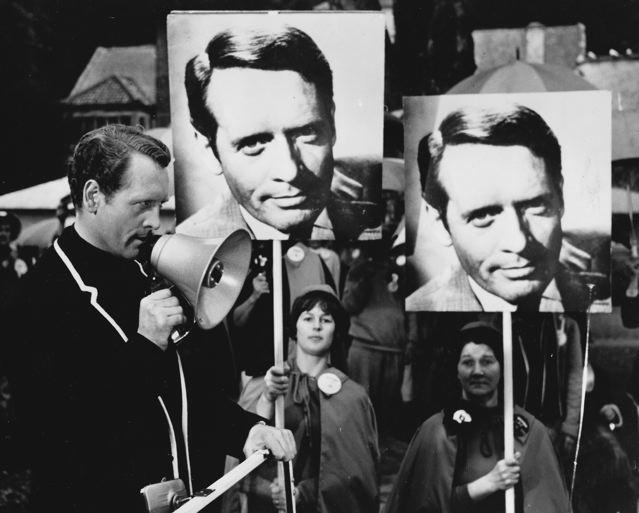
The Summer DS106 course theme is “The Prisoner.” There is a blog and a twitter feed on the “class.” I have a long relationship with The Prisoner. I watched the series on Public Television in the mid Seventies when I was a teenager. The series, starring Patrick McGoohan, is about a secret agent who resigns. He is then kidnapped and taken to an island where he is expected to not leave and provide information about why he resigned. The island is a prison disguised as a holiday resort, much like our modern internet. This series has everything: secret agents, key punch computers, surveillance, mistrust, paranoia, anti-authoritarianism, a vicious weather balloon, and lava lamps. The political metaphors and the personal anarcho-libertarianism represented by The Prisoner resonated well for teenagers in the 70s fresh out of the Nixon years and Vietnam. Bill Liddle taught a class on the Prisoner at Texas State University and he describes the series as an examination of “the struggles between society’s need to organize and control individuals, and the individual’s need to understand his or her environment to exercise personal autonomy.” I think these issues are particularly pertinent to our time because of all the questions that come up over the control of information in the internet era. In fact, I met my best friend, another catastrophically bored teenager, over a few games of chess. I noticed after a few weeks that he ended conversations abruptly with “Be seeing you!” We found that we shared a love for chess and the rebellious spirit and the metaphorical world of the Prisoner. We thought of our selves as fellow prisoners ever after.

Patrick McGoohan as Number Six, in a scene fro...

Patrick McGoohan as Number Six, in a scene from the episode “Free for All”, appears on the cover of the first continuation novel based upon the series. (Photo credit: Wikipedia)

My blog generally focuses on education and technology, but also wanders into the humanities because I find most of those specialist distinctions less useful in discovering how things became what they are today. In my experience, scientists and social scientists who lack the historical or a broad humanities background get a lot of things wrong. Looking at psychology, epistemology, or pedagogy through the lens of art can provide an accuracy that more literal approaches can miss. And The Prisoner, leaps head first into a sea of metaphor, and depending on your perspective, may or may not ever come up for air. I find the series a great companion to Marcuse (how to co-opt revolutions) and McLuhan (technology shaping us and the power of sloganeering).

Marshall McLuhan caused wide irritation with h...

Marshall McLuhan caused wide irritation with his statement that the traditional, book-oriented intellectuals had become irrelevant for the formulation of cultural rules in the electronic age. (Photo credit: Wikipedia)

So now for a few happy accidents: a few months back, my wife, knowing that I am a huge fan, insisted that I buy the box set of The Prisoner at a used book store. It is A&E’s The Complete Prisoner DVD Mega-Set (not the best video quality but it was inexpensive). Some months later, I found out that the Summer DS106 was going to be based on the Prisoner. DS 106 is the University of Mary Washington’s Digital Storytelling 106 inaugurated by Jim Groom (who also recently mysteriously resigned!). So this summer, I am hoping to connect with others as I go through the series, and connect the series to current thinking on technology and psychology.

Posted in ds106 | Tagged , , , | Leave a comment