AI and the Death of the College Essay

Robot arm writing with pen.

by Mirko Tobias Schaefer, CC BY 2.0

The Atlantic’s December issue has an essay “The College Essay Is Dead: Nobody is prepared for how AI will transform academia” by Stephen Marche that says that AI is going to make the college essay irrelevant. I say good riddance. I write this as a former English and Adult Basic Education Community College teacher. The formal essay has its uses but for why most of our students are going to school, it is an anachronistic barrier. Most are at college to get a credential for work, not to become academics. At the last college I taught at, I routinely replaced papers with group projects. I would tell the students (especially those who didn’t like group work) that your future employers are going to be more interested in how you work in a team and less interested in your ability to write a 10 page research paper. We use writing in my classes as another tool for thinking and expression, not as an end in itself. My classes were portfolio assessed. Students would have a concept map or outline, a discovery draft created in small groups, a draft for the tutor or tutoring center, and a final copy. We also used things like Pecha Kucha to present papers to the rest of the class. Coming from a Constructivist teaching background, many of my formative writing prompts begin “based on past knowledge and your personal experience, what approach would you take to solving the problem of…” You can’t download someone else’s experiences. Teaching should also be a process of relationship building, so you know your students and have some idea about their experiences.

By emphasizing writing as a product instead of a process, we only encourage the students to go to places like Course Hero or use AI tools to write. The goal of education is to meet the outcome of 5000 words right? Who cares how you get there? The fact that someone can give a chatbot a writing prompt and get an acceptable essay (in some cases) just means that teaching is really broken right now. We have commodified teaching and learning to such an extent that anything that can produce something can “get” a grade.

There may be some legitimate uses for these bots: translation, rewriting code; Bryan Alexander and Stephen Downes were talking on Mastodon about having it create lab reports. I think I have read some furniture assembly instructions that were not human generated.

There is the claim that AI can produce art. If your definition of art is the production of a picture, then I question your definition of art. If producing a picture is art then my Xerox machine is every bit as good as Leonardo Da Vinci.

Solutions?

If a student is turning to places like Course Hero or bots for homework, it means that they feel like they do not have ownership of their own education.

  • Get rid of grading. If you are not familiar with ungrading, check out “So, you want to take the grades out of teaching? A beginner’s guide to ungrading” by Susan Blum, and then take a deeper dive into the work of Jesse Stommel.
  • Emphasize process, not products. I use concept mapping and/or outlines with students depending on the students inclination. This should not just be about ferrying a student through drafts. It is an opportunity for the student to make connections with their peers, tutors, and their own knowledge and experience. The important thing is to help the student find their own process.
  • Mix papers with presentations, podcasts, or video. Once the student has a process for writing, for organizing and presenting their thoughts and research, let them explore other media: blogs, wikis, audio, video, presentations that are pure images.
  • Have the students create assignments in a collaborative process. Teach them to think and work together. Explore open pedagogical practices and courses like DS106 for alternative approaches to the traditional idea of curriculum.

The bot at Open.AI.com said it succinctly enough for a “C-“:

The use of Artificial Intelligence (AI) in the essay writing process has become increasingly popular in recent years. AI has been used to help students compose essays, from grammar and spell checking to providing more personalized feedback. AI has a number of advantages over traditional essay writing methods, including faster turnaround times and a more efficient process. But despite its advantages, AI will not end the essay writing process.

First, AI can only do so much. AI works best when it is given a specific set of instructions and data to work with. It is not capable of the same level of creativity and critical thinking that a human can bring to the essay writing process. AI can help to identify errors and provide suggestions for improvement, but it cannot provide the same level of insight and feedback as a person can. AI cannot replace the process of brainstorming, outlining and drafting that are essential for creating a successful essay.

Second, AI is not yet sophisticated enough to understand the nuances of language and writing style. AI is often used to check for grammar and spelling errors, but it is not able to understand the context of a sentence or the implications of certain words and phrases. A human can use their knowledge and experience to create a more effective essay, while AI is limited by its programming.

Knowledge is Power

It is important that we understand as much as we can about AI. Read and learn about this. Follow the stories. The real ethical issues come when we leave things like AI and learning analytics to “experts”: we risk losing the ability to make decisions about how and when AI should be used.

Posted in Academic integrity, education | Tagged , , , | Leave a comment

Remembering Char Gore

Char GoreI worked with Char Gore in my role as instructional designer at Tacoma Community College. She was the most innovative and forward-thinking instructors I had ever met. Back in 2008, she was interested in working in virtual worlds, using wikis, and experimenting with everything. She had an insatiable curiosity. As an instructor, she used that curiosity to solve problems. She was the Health Information Management instructor when I worked with her. She brought me three interesting problems: 1) by the time students got their certificate, they had to learn and relearn computer applications and databases because the technology was changing so rapidly; 2) the students were often parents with other jobs this meant was that students couldn’t always be in the physical classroom or lab; and 3) students need to be able to communicate with those working in the field to stay on top of procedural changes. While she was wrestling with these issues, George Siemens and Stephen Downes were putting together a new learning theory called “Connectivism.” One of the tenets of Connectivism is that students need to learn how to learn because schools cannot keep up with the changing pace of technology. Another tenet says that knowledge essentially resides in networks.

I was helping her to work out these problems when she asked me to co-teach a new class, Health Information Management 101 which was going to be an introduction to all of the technology the students would need to be successful as students, but also in their careers. So the course was going to be not just about technology, but how to learn new technology. It was an innovative class that basically taught me everything I needed to know about how to manage the Covid Era in education. The course was online in our learning management system (Blackboard but later in Angel), live in a lab, and simultaneously live in Elluminate (like Zoom) and on the phone. The last few weeks were held in Second Life (a virtual world), because the nursing department was using it for simulations. It was the first truly multimodal class that I had seen or experienced. If you want to checkout the syllabus, scroll down to the schedule.

Our course was loosely based on the 23 Things blog, but also on research that shows the effectiveness of learning communities and student success. We saw technology as a means of facilitating community rather than a delivery system. I think I am going to have to set up some training on how to teach this because this class would drive many our instructors insane. Requirements for coming to class asked that you have your phone on and participate in texting 🙂

Our syllabus and calendar changed a lot as we learned how this teaching in a networked class works, but syllabus is an example of what we are doing. We presented on this at the ELC conference (the one that was formerly known as Wabug).

For Char, there was never technology for its own sake: it was always about supporting the students and getting to connect with her, the other students, and those working in the professions. I really appreciated the trust she placed in me as a co-teacher. Those were some exhilarating times in education technology. I, like so many, are going to miss her. She was a very gifted teacher and person.

This is from a presentation we used to give about the class. The bulk of our presentation was demonstrating the multimodal course delivery.

Posted in education | Tagged , , , | Leave a comment

You Say Tweeter, I Say Tooter

Image of a mastodon from Charles R. Knight - http://paleo.amnh.org/artwork/knight/index.html

You say Tweeter, I say Tooter – let’s call the whole thing off!

This is just a quick note to mention my move from Twitter to Mastodon. I had pretty much had enough of Twitter years ago but I kept believing that somehow all the chaos, nonsense, open washing, all of the iterations of Course Hero, corporate-racist-antisemitic echo chambers were all going to be worth it. And I hated how much everyone just accepts that as the culture. I got tired of it. And that was before Twitter was Elon-gated. I remembered that I missed the spirit of community, experimentation, and collegiality that I found in social media in the early days. I am not saying that Mastodon is the answer but it certainly is a non-corporate jumping off point. The point of this post is to point to some articles and tools that I found helpful in understanding this space.

Amanda Siberling’s article on Tech Crunch, “A beginner’s guide to Mastodon, the open source Twitter alternative” capsulized a lot of the information I needed to understand Mastodon and to share it with my faculty. Clive Thompson’s article is also quite useful.

Chris Aldrich’s article “Your Twitter ‘Go Bag’” reminded me to download all of my information from Twitter (and how to do it), and how to find your people in Mastodon.

The way I used to use Twitter (when I was really engaged) was to link up Twitter and this blog. Could I do that with Mastodon? Frankly, I couldn’t care less – I was leaving Twitter one way or another, but Andy Piper’s Glitch page “Examples of different ways to embed Mastodon timelines (and toots) in HTML” has a link to Mastofeed which allows me to create some HTML that I can use in a WordPress widget that lets me put my Mastodon feed on this blog.

Per Axbom’s article “10 Quick Mastodon Tips” was helpful in orienting myself to the space, and I think I will be using this with other new immigrants.

I know there were others. I went to Mastodon earlier but never really did anything with it. I will let you know in this space how things fare. In the meantime, feel free to leave a comment below with any resources you found useful. If you decide to stay and remain a Musketeer, I highly recommend Geshe Langri Tangpa’s “Eight Verses for Training the Mind.”


Posted in socialmedia | Tagged , , , | Leave a comment

Open Textbooks, Open Doors (Revised)

This is the latest version of a presentation I have been giving since 2008 on open education resources. It is kind of depressing because not much has changed in the cost of education except for the fact that despite the ratcheting up of inflation, education STILL out-strips the cost of inflation and healthcare. Also, since Covid, food and shelter security for students has gotten significantly worse. The good news is that the problems have become so obvious that faculty are willing to look at alternatives. We had great conversations this week during in-service about student-led education, open education practices, OER as a social justice issue, and the fact that a textbook is not a course.

Another new thing is that I am at a technical college and I have been running into some really amazing people doing great work in the trades like Jennifer Snoek-Brown, a librarian from Tacoma Community College, who was kind enough to present this year at our OER Faculty Institute and share an epic document “OER Starting Points for the Trades.”

Posted in opentextbooks | Tagged , | Leave a comment

What is “Instructional Design”?

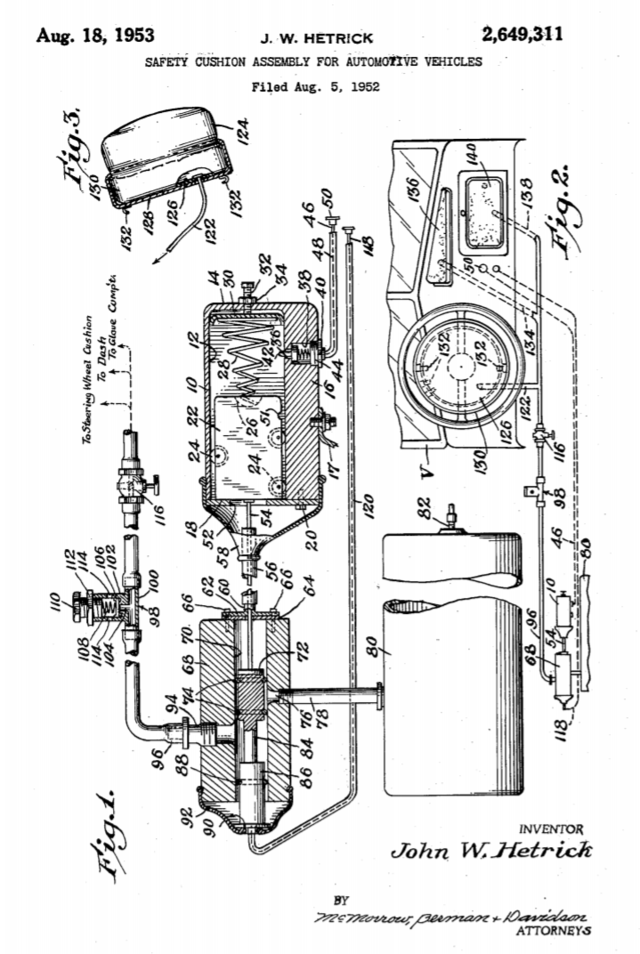
Original airbag designI like to revisit this question every year because as education changes and evolves, so does the definition of instructional design. Postings like these are always unsatisfactory because it is difficult to say that there is one thing that we do. There are a lot of moving parts.

Traditionally, instructional design is the study, practice, and process of systematically designing and developing courses, instructional materials, and learning experiences in a consistent fashion towards the effective and engaging acquisition of knowledge. The process consists of working closely with faculty to determine the state and needs of the learners, defining the outcomes of instruction, and applying the appropriate pedagogy and “interventions” to create meaningful engagement in teaching and learning.

Instructional designers work with faculty to create learning materials and experiences in face-to-face, online, and hybrid classes. Notice that the above definition does not mention education technology, multimedia, or any particular tools, but instructional designers, depending on their abilities and background, will often have skills in those tools as a means for creating effective student engagement.

Instructional designers may also review courses and course content for functionality, inclusiveness, and accessibility; assist in the broader development of programs and curricula; assist faculty in the use or creation of open education resources, and provide professional development opportunities for faculty and staff.

I call instructional designers the “Swiss Army Knives” of education: we do a little bit of everything. Instructional designers, for instance, do a lot of work on campuses to promote social justice (often without knowing it) by promoting accessibility of course materials and teaching and learning environments, or through the promotion and advocacy of open education resources and open education practices.

Feel free to leave a comment below if you have a favorite definition of instructional designer or instructional design.

Posted in instructionaldesign | Tagged , , , | Leave a comment

Organic Chemistry Textbook Goes Open Access

This in from Boyoung Chae of the Washington SBCTC via the Open WA newsletter:

Best-selling organic chemistry textbook becomes open access

Brace yourselves, chemistry students and fans of the field: John McMurry’s best-selling textbook, Organic Chemistry, is about to become free. McMurry spotted a clause in his 30-year-old contract with the publisher that allowed him to grab the copyright, and he’s publishing a new digital edition on non-profit courseware provider OpenStax. McMurry will donate his payments from OpenStax to a cystic fibrosis charity in memory of his son.

Then additionally Chemistry World reports that:

“…the aim isn’t to make publishers go out of business, McMurry says. Cengage will still make money from McMurry’s book through the supporting online material. ‘We like to have them continue selling that because a lot of students want that,’ McMurry says. He explains publishers still do add value. ‘I would not want to see them disappear, but they’re not going to make anywhere near as much money in the future.’”

Now that the book is openly licensed, it will be nice to see if the WA State Board (or a college or non-profit) takes the initiative to supplement the book with openly licensed study materials. Through H5P perhaps?


Posted in OER | Tagged , , | Leave a comment

Lumen Learning, Course Hero, and Other Strange Bedfellows

Why Does This Matter?

Most people following this story know the essential details: Lumen Learning has off-loaded openly licensed course materials to Course Hero. Edsurge has been publishing industry articles on this. If you don’t know Course Hero, it is widely considered by educators as a student cheating site: students pay or upload course materials (their own tests and papers or the work of their teachers or fellow students) in order to gain access to so-called learning materials “sample” tests, papers, exams, etc. They routinely post copyrighted faculty materials, openly licensed materials, and student papers without permission, even though they claim that this is against their user agreements. Karen Costa has reviewed many of the ethical issues around Course Hero in her blog posting back in February. I highly recommend reading that. Why this all matters centers more than on licensing semantics of open content, it covers four critical areas in the higher education space: student data, transparency, open washing, and business models.

Student Data

Course Hero has no real duty to protect student data. They seem to take no responsibility for who uploads anything or what is uploaded. There is an “agreement” not to upload materials that you do not hold the copyright to but there are no safe-guards in place. If something under copyright is uploaded, it is the copyright holder that has to go through their onerous process to get the materials taken down. They are also not bound by FERPA or any other standards of student protections. If there are any data issues, it will be the burden of the institutions that allow campus access to such sites.

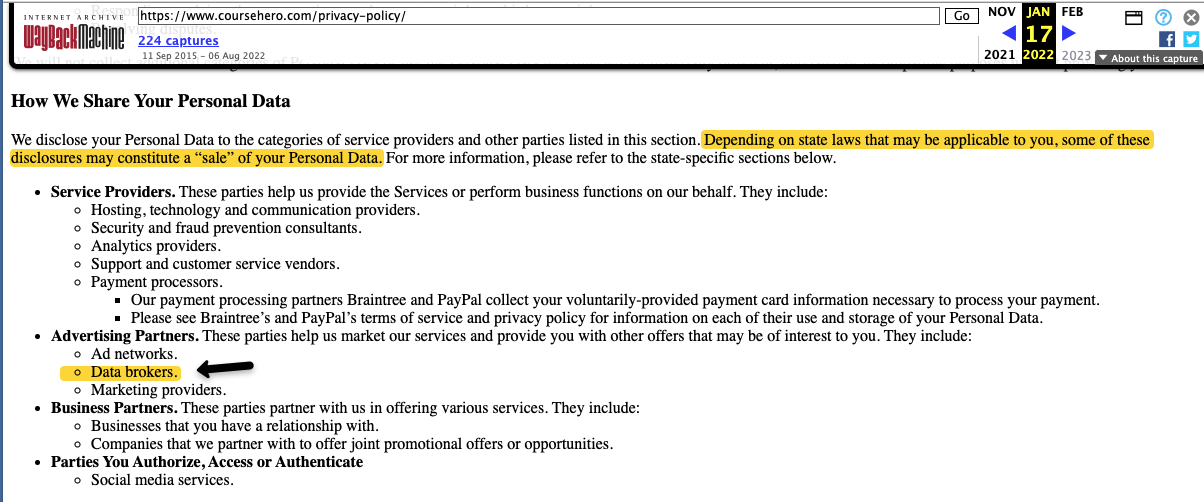
In Feb. the privacy policy still used the term "Analytics Brokers."

I went into Archive.Org and found the privacy policy from earlier this year.

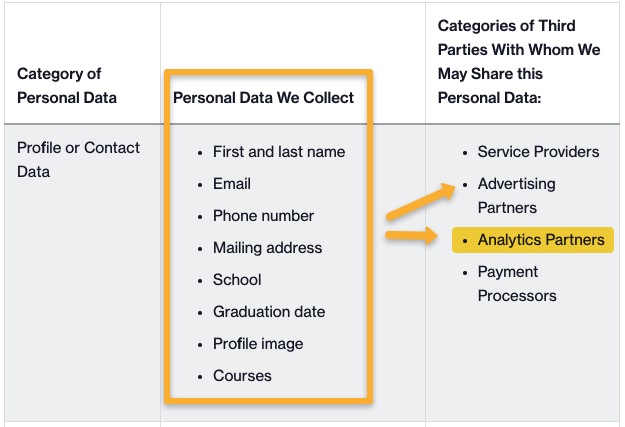
The Course Hero site since Feb. has removed the “Data Brokers” language and replaced it with “Analytics Partners” which seems to me just a more polite way of saying that they are still profiting off of student data:

Course Hero seems to have changed data brokers to analytics partners.

Course Hero seems to have changed “data brokers” to “analytics partners.”

Lack of Transparency

Also, unlike a government agency or public institution, there is absolutely no reason for Lumen Learning or Course Hero to reveal any financial details about any agreement they may have for moving open courses to Course Hero. They are not subject to public disclosures or the Freedom of Information Act. It is in THEIR best interest not to openly share information about their own company. They are businesses and not public agencies. When discussions were happening 10-12 years ago about commercial businesses being used to manage OER and open textbooks, I argued against the idea saying that they should be held by the public in the public interest and that if we turn that work over to businesses in the name of sustainability, that the OER could change hands into businesses that were less altruistic than others. Ironically, businesses competing like these, competing against public institutions and foundations, can get scarce grant monies from the organizations like the Gates Foundation to support this kind of open washing.

Open-Washing

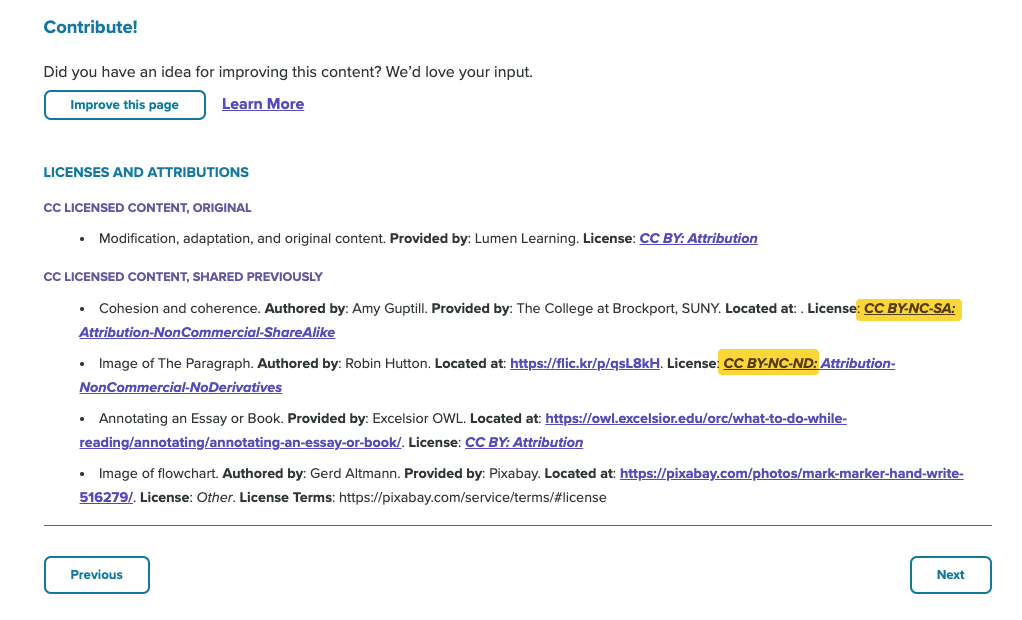
Open Education Resources, open textbooks, and open courses are being used to attract traffic to a commercial site that sells student data to data brokers (or “analytics partners”) and requires faculty and student information for access. This is certainly against the spirit of open. In my opinion, turning a blind-eye to Course Hero practices is unethical and  an irresponsible use of open licensed materials. I believe that this is why David Wiley and others were so adamant about the Creative Commons license “NC” (non-commercial) be considered “less open” because it interfered with private business profits. I have heard David Wiley and others claim that they are not selling OER but a platform. That is like selling jewelry but claiming it is the packaging and not the jewelry you are selling. If there were no jewelry in the box, no one would buy it. Even Creative Commons continues to push that idea despite the fact that it only benefits corporations and has nothing to do with protecting faculty intellectual property from exploitation by irresponsible actors or protecting students which might be the best arguments for a non-commercial license. Creative Commons lists the non-commercial license as “less open” but we always have to ask “less open for whom?” What is fascinating is that for all the arguments against using the NC license, Lumen Learning uses a lot of material with NC on it. So using an NC license must be just fine because it is not changing how they use the material at all. Take the case of Lumen’s English I textbook. Like much of Lumen’s properties it has content that is labeled “NC”:

My question to Lumen Learning would be this: is your current use of these materials what you think the authors of the material intended for them to be used? I am sure there are some legal gymnastics that allow for this, but I would contend that no one would expect a corporation to repackage faculty work for profit with this license let alone have it passed off to what is widely regarded as a student cheating site.

Business Models

We will always have vendors of some kind in the education sector. The cost of doing business should not be the safety of the students or the exploitation of faculty intellectual property by bad or irresponsible actors. The solutions are already here: there are education institutions, non-profits, and foundations that are already supporting OER. There are other business models out there that we should be supporting rather than unaccountable corporations that play fast and loose with student data. There are foundations and non-profits whose bottom line relies and trust and relationships rather than money.

Be The Change

Many colleges block access to Course Hero because of its reputation as a student cheating site. In the latest Edsurge industry piece, Sean Michael Morris, Vice President of Course Hero, is quoted as saying “’As a representative of Course Hero, I would say, try to get your university to not block us anymore. That would be great,’ Morris says, later clarifying that that was a joke. ‘But honestly, I mean, the OER is generally available other places as well,’ meaning that other sites are also hosting the text from these open course materials.” I would encourage colleges and other institutions to block such sites as long as they continue to traffic in student data to data brokers which is something that generally the “other places” don’t do.

But we have to do more than that. There are a lot of things we are already doing that can remedy this situation.

  • Hold corporations accountable for how they handle student data. Institutions should vet corporations for how they handle student data just as we should with accessibility. It is not enough that a corporation “follows the local laws,” the laws have not yet caught up with ability for data brokers to re-aggregate data and to put student information at risk.
  • Student care should come first. The right for students and faculty to be safe should over-ride the right for someone to make a profit.
  • Ask your state to partner with universities and libraries to promote and publish OER.
  • Hold free, open events in your colleges and institutions to promote and support OER. Build institutional networks that support, promote, and create OER and Open Education Practices.
  • Public institutions should be favoring non-profits, foundations, and open source. We need to re-think our spending to help create long-term relationships and networks of creation and support over vendors whose commitment, accountability, and ethical values will change with every new owner and partnership.
  • We need to hold more discussions in the education community about the ethical expectations we should have with OER.

In-house solutions to OER take time: they can be cumbersome and they do cost money, but education should be in the hands of educators who are held to standards and protections that commercial businesses are not.

Posted in OER | Tagged , , , , | Leave a comment

OER Faculty Institute Update

The logo of Clover Park Technical CollegeAttached you will find the program for the OER Faculty Institute hosted by the Teaching & Learning Center at Clover Park Technical College. From our previous notice:

Clover Park Technical College is excited to host our first OER Faculty Institute!
Dates: Friday, August 5 and Saturday, August 6
Time: 9 am to 3 pm 

There will be keynote presentations from internationally recognized professional/technical colleges as well as breakout sessions on finding OER, accessibility in OER, open licenses, as well as panels on prof/tech OER opportunities and challenges, and a panel on OER and librarians.  

Although some sessions are prof/tech focused, we are opening the institute to all community and technical colleges to encourage a wide participation and collaboration on OER initiatives. 

There is no cost to attend and it is held virtually via Zoom. 

We welcome your participation and look forward to seeing you at the institute! 

Please fill out the event registration form 

CPTC Health Sciences building

Posted in OER | Tagged , , | Leave a comment

OER Faculty Institute

Clover Park Technical College is excited to host our first OER Faculty Institute! 

Dates: Fri., Aug. 5th and Sat., Aug. 6th
Time: 9 am to 3 pm (PST)

The Teaching & Learning Center at Clover Park Technical College is hosting a free, two day event: the OER Faculty Institute. There will be keynote presentations from internationally recognized professional/technical colleges as well as breakout sessions on finding OER, accessibility in OER, open licenses, as well as panels on prof/tech OER opportunities and challenges, and a panel on OER and librarians.  

Although some sessions are prof/tech focused, we are opening the institute to all universities, community and technical colleges to encourage a wide participation and collaboration on OER initiatives. 

There is no cost to attend and it is held virtually via Zoom. We welcome your participation and look forward to seeing you at the institute! 

Please fill out the event registration form to attend. 

The logo of Clover Park Technical College

Posted in education | Tagged , , , | Leave a comment

Back to the Future: Chickering and Gamson

Movie Poster from "Back to the Future." I am gathering a few resources from when I started my career in education and instructional design that are currently being resurrected in the name of <insert grant-worthy buzzword here>. Arthur W. Chickering and Zelda F. Gamson wrote the “Seven Principles for Good Practice in Undergraduate Education” in 1987 to improve teaching and learning. In 1991, Chickering and Gamson published a book titled Applying the Seven Principles for Good Practice in Undergraduate Education. The original article and book are based on decades of research on undergraduate education supported by the Association for Higher Education, The Education Commission of States, and the Johnson Foundation. There is a lot here that you will also find in ACUE, TILT, Open Pedagogy and other more modern frameworks for teaching and learning. It there are any fins on this old Cadillac, it is number 6, “Communicate high expectations,” but when you look under the hood on that one, there is still a spirit of student-centered learning.

The Seven Principles for Good Practice in Undergraduate Education

  1. Encourage contact between students and faculty
  2. Develop reciprocity and cooperation among students
  3. Encourage active learning
  4. Give prompt feedback
  5. Emphasize time on task
  6. Communicate high expectations
  7. Respect diverse talents and ways of learning

From “The Seven Principles for Good Practice in Undergraduate Education”

“These seven principles are not ten commandments shrunk to a 20th century attention span. They are intended as guidelines for faculty members, students, and administrators – with support from state agencies and trustees — to improve teaching and learning. These principles seem like good common sense, and they are — because many teachers and students have experienced them and because research supports them. They rest on 50 years of research on the way teachers teach and students learn, how students work and play with one another, and how students and faculty talk to each other.”

Application

The following information includes an explanation of each of the Seven Principles of Undergraduate Education as well as examples of how an instructor may apply the seven principles in the development and instruction of all courses including online, hybrid and regular enrollment courses.

  1. Encourage contact between students and faculty
    “Frequent interaction with faculty members is more strongly related to satisfaction with college than any other type of involvement, or, indeed, any other student or institutional characteristic.” (Astin, 1985, pp. 133-151)

    1. Utilize virtual or regular classroom environments to hold synchronous class activities and provide opportunities for the students to interact with the instructor at a distance by using a web conferencing tool.
    2. Provide personal feedback quickly to students on assignments and assessments. Utilize rubrics for projects and papers to standardize grading and provide built-in feedback.
    3. Hold office hours (virtual and in person), make opportunities for review sessions and study groups using a virtual classroom, and/or utilize the chat feature of your Learning Management System (LMS).
    4. Provide opportunities for discussions using discussion activities and comment on student posts to show a “presence” in the course.
    5. Give work and study groups discussion boards for their use and “check-in” to see how students are progressing.
  2. Develop reciprocity and cooperation among students: “Students’ academic performance and satisfaction at college are tied closely to involvement with faculty and other students around substantive work.” (Light,1992, p. 18)
    1. Provide opportunities for collaboration such as discussion, group projects and assignments, and peer evaluation.
    2. Utilize the tools in an LMS to provide students with a discussion and collaboration space.
  3. Encourage active learning: Learning is not a spectator sport. To internalize learning students must talk about what they are learning, write reflectively about it, relate it to past experiences, and apply it to their daily lives.
    1. Provide opportunities for students to interact with content during presentations or lectures utilizing tools such as video discussion platforms, social media, or live classroom response systems.
    2. Allow students to relate the material to their own interests through reflections and presentations.
    3. Encourage self-evaluation and peer-review.
    4. Provide students with rubrics for evaluation and have multiple students evaluate the same project by using the collaboration tools, chats, or discussion boards.
    5. Discover the various communication tools and applications of your LMS to provide opportunities to interact with the content and each other.
  4. Provide effective and prompt feedback: Recognizing and understanding gaps of knowledge will help guide student learning.
    1. Respond to student queries and problems quickly.
    2. Utilize discussions, polling, and/or social media during or after a lecture to provide opportunities for students to ask questions.
    3. Utilize rubrics for grading projects and papers to standardize grading and provide prompt feedback to students.
    4. Utilize low-stakes assessments to provide students with frequent assessments of their learning and provide frequent feedback on progress.
    5. Provide frequently updated student grades by using the gradebook feature in your LMS.
    6. Respond to distance students within a 24 hour time period if possible. If this is not realistic for the instructor, outline in the syllabus what students can expect for instructor response times.
  5. Emphasize time on task: Time plus energy equals learning. Learning to use one’s time well is critical for students and professionals alike. Allocating realistic amounts of time means effective learning for students and effective teaching for faculty.
    1. Emphasize deadlines in the syllabus and provide students with reminders about upcoming deadlines. Utilize social network platforms or LMS announcements to send brief reminders or bits of information to students.
    2. Give consistent and frequent deadlines to distance students such as weekly discussion requirements by the same day/time each week, low-stakes quizzes on the same day/time each week, and weekly reminders to continue work on long-term projects.
    3. Break large projects into smaller, more manageable pieces and require students to hit benchmarks during the duration of the project. For example, require students to present a brainstorming list, an outline, resources, a rough draft, and a final draft to a paper or project.
  6. Communicate high expectations: Expect more and you will get it. High expectations are important for everyone – for the poorly prepared, for those unwilling to exert themselves, and for the bright and well-motivated. Expecting students to perform well becomes a self-fulfilling prophecy.
    1. Provide students with detailed explanations and expectations in the syllabus.
    2. Provide students with rubrics for projects and papers detailing what must be accomplished and the grade value for each item. This allows students to know exactly what is expected of them.
    3. Set realistic expectations for course activities and assessments that communicate high but attainable expectations.
  7. Respect diverse talents and ways of learning: Many roads lead to learning. Different students bring different talents and styles to college. Students need opportunities to show their talents and learn in ways that work for them. Then they can be pushed to learn in new ways that do not come so easily.
    1. Develop and implement the course using proven learning theories.
    2. Incorporate a variety of activities into the course including collaboration, group and individual projects, papers, low stakes assessments, and discussions to reach a variety of learning preferences.
    3. Present course materials in a variety of methods to reach the most modalities possible.

References and Additional Resources for Exploration

AAHE’s seven principles for good practice applied to an online literacy course: A scholarly article from the Journal of Computing Sciences in Colleges discussing the application of the Seven Rules of Undergraduate Education in an undergraduate online course at Middle Tennessee State University. The paper discusses best practices, course development, class procedures and recommendations.
The Implications of the Norms of Undergraduate College Students for Faculty Enactment of Principles of Good Practice in Undergraduate Education: A scholarly article from the Peabody Journal of Education examining empirical evidence for the support of the Seven Rules of Undergraduate Education. The article includes the implication for theory and practice in the context of the study.

Adapted from “Chickering and Gamsom.” (n.d.) Information Technology. University of Florida.

https://web.archive.org/web/20100415195904/http://www.tltgroup.org/seven/Library_TOC.htm

Posted in teaching | Tagged , , , , | Leave a comment